

Oct 01, 2026

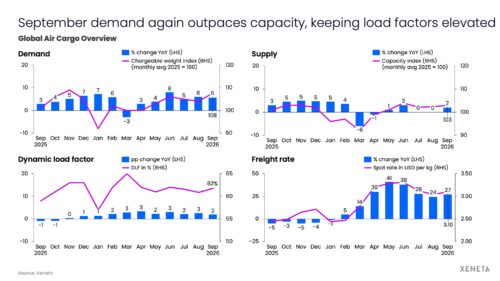
- Global demand increased 6 percent year-on-year in September, while spot rates reached US$3.10 per kg, up 27 percent year-on-year. Capacity grew by just 2 percent, pushing utilisation higher.
- 60 percent of new Q3 contracts were for three months or less, up from 25 percent a year earlier, as shippers avoid fixed annual rates amid market volatility and increasingly seek floating pricing mechanisms.
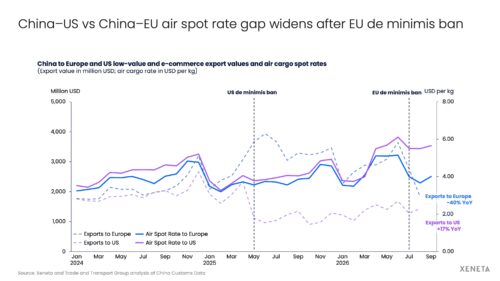
- China-Europe e-commerce volumes fell 40 percent year-on-year in August following the EU’s new customs duty, while China-US volumes rose 17 percent. Middle East disruption continues to support elevated rates, but Xeneta expects a relatively subdued Q4 unless ocean freight disruption drives more cargo into airfreight.
Global airfreight demand rose 6 percent year-on-year in September, pushing spot rates higher and prompting shippers to rethink long-term capacity commitments as uncertainty over pricing persists.
The latest data from Xeneta shows global air cargo volumes continued to grow at a steady pace through the third quarter, following increases of 6 percent in August and 5 percent in July.
But the growth in demand is increasingly being reflected in capacity utilisation and pricing. Available capacity was up only 2 percent year-on-year in September, while Xeneta’s dynamic load factor, its measure of capacity utilisation, rose by two percentage points to 62 percent.
Global airfreight spot rates averaged US$3.10 per kg during the month, 27 percent higher than a year earlier and 2 percent above August.
The rise came as the market entered its traditional late-third-quarter seasonal upswing, while higher jet fuel costs added further pressure. Brent crude briefly moved above US$100 a barrel in early September amid continuing tensions in the Middle East.
 Shorter contracts replace fixed annual commitments
The clearest change is emerging in the way shippers are buying capacity. Xeneta’s analysis of new contracts starting in Q3 2026 found that 60 percent were for three months or less, compared with 25 percent a year earlier and 47 percent in Q2.
Three-month contracts accounted for 42 percent of new agreements, up from 16 percent in Q3 2025. At the same time, the proportion of 12-month contracts fell from 40 percent to 25 percent. Contracts lasting more than a year accounted for just 3 percent of new business.
Niall van de Wouw, Xeneta’s chief airfreight officer, said shippers were increasingly seeking pricing arrangements that could move with market conditions rather than committing to fixed annual rates. “A one-year fixed rate deal doesn’t fit the current conditions.”
Shippers are looking for what Xeneta describes as “floating mechanisms”, with a base rate adjusted according to changes in the market.
“There is a high degree of realism in the way shippers are approaching the market,” van de Wouw said. “There remains a lot of instability and that’s making it almost impossible for shippers to make long-term capacity deals without having T&Cs in place to deal with these volatile conditions.”
China-Europe e-commerce volumes fall
The airfreight market is also being reshaped by changes in e-commerce flows between China, Europe and the US. China’s low-value and e-commerce exports to Europe fell 40 percent year-on-year in August, according to Xeneta and Trade and Transport Group analysis of China Customs data. That followed a 25 percent decline in July.
The fall has coincided with the introduction of the EU’s €3 customs duty on individual items from 1 July. China-US e-commerce exports moved in the opposite direction, rising 17 percent year-on-year in August as the market continued to recover from the removal of the US de minimis threshold in 2025, although volumes remain measured against a lower base.
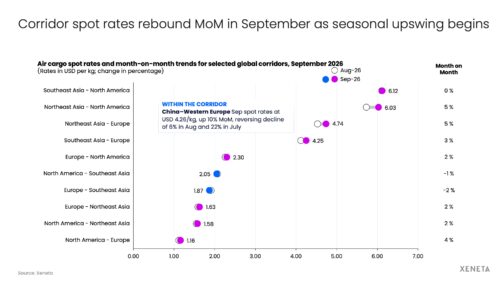
The divergence is increasingly visible in freight pricing. China-Western Europe airfreight spot rates rose 10 percent month-on-month in September to US$4.26 per kg, reversing declines recorded in July and August. Xeneta attributed the September rebound partly to stronger outbound China demand ahead of Golden Week.
 Across other major corridors, rates also began their seasonal recovery. Northeast Asia-Europe increased 5 percent to US$4.74 per kg, while Northeast Asia-North America rose 5 percent to US$6.03 per kg. Southeast Asia-Europe rates were up 3 percent. Transatlantic rates strengthened in both directions, with Europe-North America up 2 percent and North America-Europe up 4 percent.
Middle East remains the main source of disruption
The strongest rate increases relative to late February remain on routes into the Middle East. By week 39, covering 21-27 September, rates were 91 percent higher from South Asia and 80 percent higher from Europe than before the escalation of the Iran war.
Northeast Asia-North America and Southeast Asia-North America rates were also 34 percent and 29 percent above late-February levels respectively, supported by recovering e-commerce traffic and shipments linked to artificial intelligence infrastructure.
Europe-North America remains an outlier, with spot rates 20 percent below late-February levels, although the gap has narrowed from 25 percent in August as summer belly capacity leaves the market.
 Muted peak season expected
Despite the stronger-than-expected growth seen so far in 2026, Xeneta expects the airfreight market to remain relatively subdued through the final quarter.
“What will happen in Q4 is too early to call, but the indicators currently point towards a muted final quarter of the year,” van de Wouw said.
One potential catalyst could come from the ocean freight market. Persistent schedule unreliability, renewed disruption in the Red Sea and port congestion have pushed some Asia-US West Coast ocean rates back towards pandemic-era levels. If the cost and reliability gap between ocean and air widens further, more cargo could shift to airfreight.
“We are not yet seeing that in the September data,” van de Wouw said. “But it is the factor we are watching most closely.”
The post Shippers turn to short-term airfreight deals as demand growth keeps rates elevated appeared first on Air Cargo Week.
Go to Source
Author: Edward Hardy
Latest Posts