
Jun 08, 2026
- Morocco’s logistics proposition is in its role as a cross-continental node linking Europe, West Africa and Atlantic shipping lanes, with growing relevance for hub-and-spoke freight models and multimodal routing efficiency.
- Geography and trade architecture sit at the core of the value proposition: Morocco functions as a proximity-based gateway into Southern Europe while strengthening Africa-bound corridors, supported by extensive free trade agreements reaching over one billion consumers and enabling re-export, industrial diversification and cold chain-led agribusiness flows. Association of Freight Forwarders Morocco (AFFM)
- Competitiveness is reinforced by structural stability and executional efficiency, with streamlined business formation, improving regulatory clarity and a young multilingual workforce feeding logistics, customs and supply chain services; together these factors reduce friction costs and support faster deployment of warehousing and distribution capacity across the country.
Morocco’s logistics relevance is increasingly defined by geometry as much as policy. Sitting between European consumption hubs, West African growth corridors and Atlantic maritime lanes, it has evolved into a natural consolidation point for cargo moving across three continents. For freight forwarders, the operational implication is straightforward: shorter lead times into Southern Europe and more predictable routing options for Africa-bound freight, particularly where multimodal solutions are required.
The strategic value of this positioning is embedded in the way cargo flows are structured through ports, airfreight gateways and inland distribution nodes. The country’s proximity to Europe compresses transit cycles, while maritime integration supports scalable throughput for containerised volumes and transhipment activity. In practice, this enables forwarders to rebalance networks towards hub-and-spoke models anchored in North Africa rather than relying solely on European gateways.
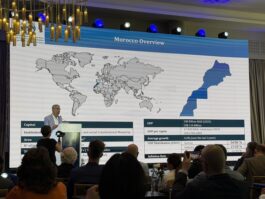
“The country has established itself as a key maritime and logistics hub, increasingly serving as a gateway between Africa and global markets. Geographically, Morocco occupies a unique position at the crossroads of Europe, Africa, and the Atlantic. Major European markets are only a few hours away by air, while maritime links ensure efficient access to international trade routes,” Rachid Tahri, President of the Association of Freight Forwarders Morocco (AFFM), told the audience at the 10th annual Neutral Air Partners conference in Marrakech, Morocco.
Stability remains the underpinning variable that allows this positioning to function at scale. Predictability in governance and institutional continuity reduces friction costs across customs, insurance, and contract enforcement. For cargo operators, this translates into fewer operational contingencies and more confidence in long-range routing decisions, particularly for high-value or time-sensitive flows.
“The country has enjoyed strong political stability and robust institutions. The 2011 Constitution strengthened democratic governance, human rights, individual freedoms, and the rule of law. This stable political environment provides investors with long-term visibility and confidence, positioning Morocco as one of the most secure and stable countries in North Africa and the wider Arab region,” Tahri continued.,
Trade architecture and access
Morocco’s trade environment is increasingly shaping its role as a re-export and distribution platform rather than a purely origin-export economy. The breadth of its free trade agreements provides freight forwarders with a structural advantage: cargo can be routed through Morocco into multiple jurisdictions without the same tariff drag experienced in adjacent markets. This shifts the country from a transit point to a value-adding hub in global supply chains.
For logistics operators, the practical effect is diversification of cargo types and directional flows. Export-led manufacturing, automotive components, agribusiness and light industrial goods all converge into a system designed for outward connectivity. This creates scope for forwarders to bundle services across customs clearance, warehousing and last-mile export consolidation, improving yield per shipment while maintaining velocity.
“One of Morocco’s greatest advantages is its extensive network of free trade agreements. It benefits from preferential access to markets covering more than one billion consumers, including the European Union, the United States, Turkey, and numerous African partners. This positions Morocco as a strong export platform for companies seeking international reach,” Tahri outlined.
Agricultural and industrial diversification further strengthens the cargo base, particularly in temperature-controlled logistics and packaging-led export chains. This is not a single-sector story but a layered ecosystem where freight demand is generated across multiple verticals simultaneously. The implication is resilience: downturns in one segment are partially offset by activity in others, stabilising overall cargo throughput.
“The country is also a leading agricultural producer and exporter in Africa, supported by diverse production, modern farming techniques, and strong food-processing capabilities. Opportunities span the entire value chain, including packaging, cold chain logistics, agricultural inputs, and export-oriented agribusiness. Ongoing reforms continue to improve the business environment, including legal protections for investors, administrative simplification, and stronger governance frameworks,” he continued.
Efficiency and investment
At the operational level, Morocco’s logistics competitiveness is increasingly defined by efficiency gains in business formation and trade execution. Reduced administrative friction shortens onboarding cycles for new logistics entities and accelerates the deployment of warehousing, forwarding and distribution capacity.
The simplification of procedures is particularly relevant in a cargo environment that depends on speed of reaction. As supply chains fragment and become more regionalised, the ability to establish operations quickly becomes a differentiator. Morocco’s reforms effectively reduce fixed entry barriers, allowing logistics players to scale infrastructure in response to demand signals rather than structural delays.
“Starting and operating a business in Morocco has become increasingly streamlined. Procedures for company formation, trade, and investment execution have been simplified, contributing to lower operating costs and faster market entry. The workforce is another key asset,” Tahri laid out.
Human capital reinforces this operational base, particularly in multilingual coordination across European, African and Middle Eastern trade lanes. The availability of technically trained graduates supports the expansion of freight forwarding, customs brokerage and supply chain analytics functions. For logistics networks, this reduces dependency on imported expertise and strengthens local execution capability.
“More than 60 percent of the population is under the age of 34, creating a young and dynamic labour pool. Each year, thousands of engineers and graduates enter the market, supported by strong language capabilities in French, Arabic, Spanish, and English. Training institutions help ensure alignment between workforce skills and industrial requirements” he expressed.
The post Morocco’s rising role in global trade appeared first on Air Cargo Week.
Go to Source
Author: Edward Hardy
Latest Posts