
Apr 15, 2026

- The loss of patent protection for semaglutide in India has materially altered the competitive landscape for the Danish pharmaceutical company Novo Nordisk.
- Semaglutide, the active ingredient in its flagship therapies Wegovy and Ozempic, had underpinned a strong market position.
- With exclusivity removed, the Indian market has seen an immediate influx of generic alternatives, driving a sharp reduction in prices of weight-loss treatments by as much as 80%.
Within days of the patent expiry, numerous domestic manufacturers entered the market, leveraging India’s extensive pharmaceutical manufacturing capabilities. Prices were driven down by up to 90%, with monthly treatment costs falling to levels that significantly undercut those typically associated with multinational pharmaceutical firms. This rapid response underscores India’s established reputation as the “pharmacy of the developing world”, reflecting both scale and cost efficiency.
The development comes against the backdrop of strategic change at Novo Nordisk, including the departure of its long-serving chief executive, Lars Fruergaard Jørgensen. The company had been pursuing expansion into emerging markets such as India, China and the Middle East, but now faces intensified competition from a highly capable domestic industry.
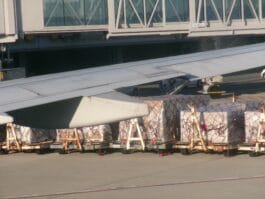
These products are natural fits for bellyhold or maindeck airfreight shipments, likely to transit over the Middle East to markets in Europe and North America and Africa, especially from Indian manufacturing laboratories.
It is for airfreight activity like that the Belgium-based trade body has taken the time and effort to create a White Paper about the current situation in the Middle East. The paper is authored by a group of specialists who bring together academic expertise, industry experience and global supply-chain leadership. Heading the effort is Frank Van Gelder, secretary general, Pharma Aero and Prof Dr Wouter Dewulf, professor of air transport management and economics, University of Antwerp. Their operational experience, from clinical trial logistics to commercial distribution, ensures that the recommendations are presented grounded in real-world practice.
The White Paper states: “The Gulf region has become one of the world’s most important transit points for pharmaceutical cargo. The recent geopolitical crisis has shown how vulnerable this system has become. In response to the unfolding situation, Pharma.Aero organised a dedicated industry webinar bringing together industry and academic expertise to assess the implications for life science supply chains.
“Attended by more than 100 professionals, and executives from across the global pharma logistics ecosystem, the special briefing examined how rising geopolitical tensions in the Gulf region and the resulting uncertainty across key global transport corridors may affect pharmaceutical logistics worldwide, where reliability and product integrity are critical. As highlighted in the webinar, “21.7% of all global cargo is impacted” by the disruption, a reminder that the effects extend far beyond the region itself.
“This white paper explains the nature of the disruption, why pharmaceutical supply chains are particularly exposed, and what steps the global community can take to strengthen resilience. It draws on the webinar materials and peer-reviewed research to provide a balanced and accessible overview for an international audience.”
As the disruption continues, influence shifts towards carriers and corridors that can offer stable alternatives. Due to the geopolitical crisis in the Middle East, “network power shifts to alternative carriers and corridors” when Gulf hubs are compromised. Research shows that geopolitical strain can reshape long-term investment decisions and alter access to medicines.
Middle Eastern carriers represent around 10.7% of global air cargo capacity, yet disruptions in the region affect more than double that share of global flows. This is because the Gulf acts as a bridge between continents, especially for Europe-Asia trade.
Reduced capacity and longer routes
At the start of March 2026, global air cargo capacity fell by 22%. Although this later improved to -13% and then -8%, the recovery has relied heavily on airlines adding direct Europe-Asia flights. This growth has been driven by “direct flying, Chinese carriers and charter airlines.” Chinese carriers, in particular, have been able to use Russian airspace, giving them an advantage at a time when many Western airlines face restrictions due to the Russian/Ukrainian war.
While higher freight rates are a concern, the more serious issue is the loss of reliability. The crisis is seen as “primarily a reliability crisis, not just a cost crisis.” Longer routes, more handovers and increased storage time all raise the risk of temperature excursions and product degradation. This reflects a broader trend identified in academic research: medicine shortages increasingly result from disruptions in manufacturing, distribution and transport rather than from demand spikes alone.
Risk of relying heavily on Gulf
The paper comments: “For years, the industry has discussed the risks of relying heavily on the Gulf as a logistics hub. Those concerns have now become reality. As the briefing notes, “Middle East airspace and maritime routes are disrupted amid ongoing Gulf instability.”
“This has created delays, congestion and uncertainty across global transport networks. The Gulf’s importance is the result of decades of investment in aviation, infrastructure and connectivity. Dubai, Doha and Abu Dhabi together handle 2-2.5 million tonnes of cargo each year, acting as major transfer points between Europe, Asia, Africa and North America. For pharmaceuticals, which depend on speed, temperature control and predictable routing, this concentration of activity brings both efficiency and risk.
Pharmaceutical manufacturers, logistics providers, and supply chain stakeholders must shift from efficiency-driven models toward resilience-centric operating strategies. This entails embedding redundancy, flexibility, and risk mitigation into network design, even where this introduces higher short-term costs. Companies should secure long-term, strategic capacity agreements with logistics partners, particularly in air freight and temperature-controlled transport, to safeguard access during periods of volatility. Investment in scenario planning, stress testing, and digital twin technologies is critical to anticipate disruptions and evaluate response strategies in complex, high-stakes environments.
Furthermore, industry must expand cold-chain and specialised handling capabilities beyond primary hubs, strengthening secondary and regional nodes to enable decentralised, patientcentric distribution models, especially for advanced and precision therapies.
International organisations play a pivotal role in orchestrating a coherent global response to pharmaceutical supply chain risks. They should lead the development of coordinated emergency logistics frameworks, ensuring alignment across countries, regulators, and industry actors during crises. A key priority is to support low- and middle-income countries and vulnerable regions, which are disproportionately affected by supply disruptions, through targeted capacity-building, funding mechanisms, and equitable allocation strategies. In addition, international bodies should facilitate transparent, real-time global data-sharing platforms, enabling early visibility of disruptions, demand surges, and bottlenecks across the supply chain ecosystem.
Conclusion
The Gulf crisis has exposed how fragile the global pharmaceutical logistics system has become when it relies on speed, central hubs and predictable transit routes. What once offered efficiency now magnifies risk, threatening the timely delivery of life-saving medicines worldwide. This event is part of a larger pattern of geopolitical instability that disproportionately affects vulnerable, import-dependent countries. The lesson is clear: the global pharmaceutical community cannot rely solely on efficiency; it must build resilience into every layer of the supply chain.
Achieving this means diversifying routes and hubs, creating redundancies in storage and transport, investing in real-time visibility and predictive monitoring, and strengthening international collaboration.
By taking these steps, stakeholders can ensure that medicines reach patients safely and reliably, even when the unexpected strikes. The Gulf crisis should serve as a wake-up call: resilience is not optional; it is essential for protecting health worldwide.
The post Pharma.Aero studies geopolitical Instability in the Gulf appeared first on Air Cargo Week.
Go to Source
Author: James Graham
Latest Posts