- Escalating tensions in the Middle East are beginning to ripple across global air cargo networks, with multiple airspace closures forcing airlines to reroute flights and suspend operations across key transit corridors.
- New analysis from WorldACD Market Data highlights the scale of the exposure.
- Based on global air cargo volumes by weight between November 2025 and January 2026, approximately 21 percent of worldwide air cargo flows are directly linked to the Middle East — either originating, terminating, or transiting through the region.
The war in Iran and the resulting airspace restrictions across parts of the Middle East are directly affecting a significant share of global air cargo flows, highlighting the region’s central role in international supply chains.
According to new analysis by WorldACD Market Data, approximately 21 percent of worldwide air cargo flows are directly linked to the Middle East when measured by weight between November 2025 and January 2026.
The figures reflect cargo that either originates in the region, is destined for it, or passes through major Middle Eastern hubs acting as transit gateways between continents.
WorldACD’s breakdown of global cargo flows shows that:
• 0.4 percent of global air cargo moves within the Middle East itself
• 2.2 percent flows from the Middle East to global destinations
• 8.8 percent travels from worldwide origins to the Middle East
• 9.5 percent of global cargo is transported via Middle Eastern hubs
Together, these flows account for 21 percent of global air cargo activity, underlining the strategic importance of the region’s aviation network.
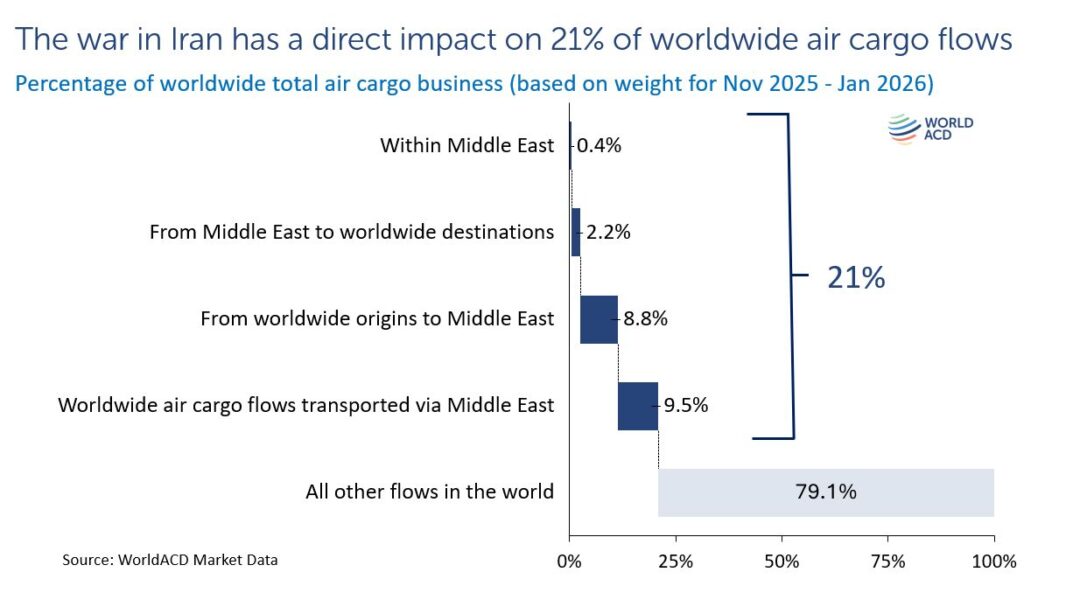
The largest share comes from transit cargo moving through the Middle East, which accounts for 9.5 percent of global volumes.