
Apr 09, 2026

- New data from Cirium shows capacity across key hubs remains sharply reduced, even as cancellation rates fall, pointing to a deeper structural adjustment rather than a short-term disruption.
- When the conflict began, Cirium data showed an immediate and severe shock to Middle East departures at the onset, tempered by a steady normalisation.
- On February 28, around 37% of flights were cancelled or did not operate, but within the first days of the conflict, cancellation rates peaked above 65%, with more than 2,300 daily departures grounded.
Capacity reductions across Dubai (DXB), Doha (DOH) and Abu Dhabi (AUH) point to a sharp contraction in one of the world’s most critical aviation corridors. In the second half of April (16–30 April 2026), scheduled capacity at DXB and DOH fell by around 50% year-on-year across flights, seats and available seat kilometres (ASKs), underlining the depth of the adjustment taking place at the core of east–west connectivity. Abu Dhabi has seen a more moderate decline, with capacity down between 18% and 31%, suggesting a more selective reduction in frequencies rather than long-haul capacity.
The implications extend far beyond the region. Gulf carriers play a disproportionately large role in intercontinental traffic flows, particularly between Europe, Asia and Australasia. According to Cirium, Emirates alone carries more than 13% of Europe–Asia passengers and over 31% of Europe–Australasia traffic, with Qatar Airways and Etihad adding further concentration. Any disruption at these hubs therefore translates quickly into global capacity constraints.
The impact of the conflict varies sharply by airport, with a divide between disrupted regional airports and slightly more resilient global hubs. The largest hubs, Dubai (DXB) and Abu Dhabi (AUH), maintained cancellation rates around 48-50%. In ordinary times, that counts as a severe disruption. However, Doha International Airport (DOH) had nearly 80% of its operations impacted. Tel Aviv (TLV) experienced extremely high disruption (around 86%).
On the part of the airlines, Qatar Airways saw very high disruption at around 77%, significantly worse than its competitors Emirates and Etihad, at 32% and 49% respectively.
Among major international carriers, the U.S. and European airlines halted operations aggressively: Major carriers including Delta Air Lines, United, American, and Air Canada have suspended operations. Carriers such as British Airways and Lufthansa maintained partial operations where operationally feasible. It is not possible to predict a return to normal operating schedules at this point. That lays squarely in the domain of the airlines themselves.
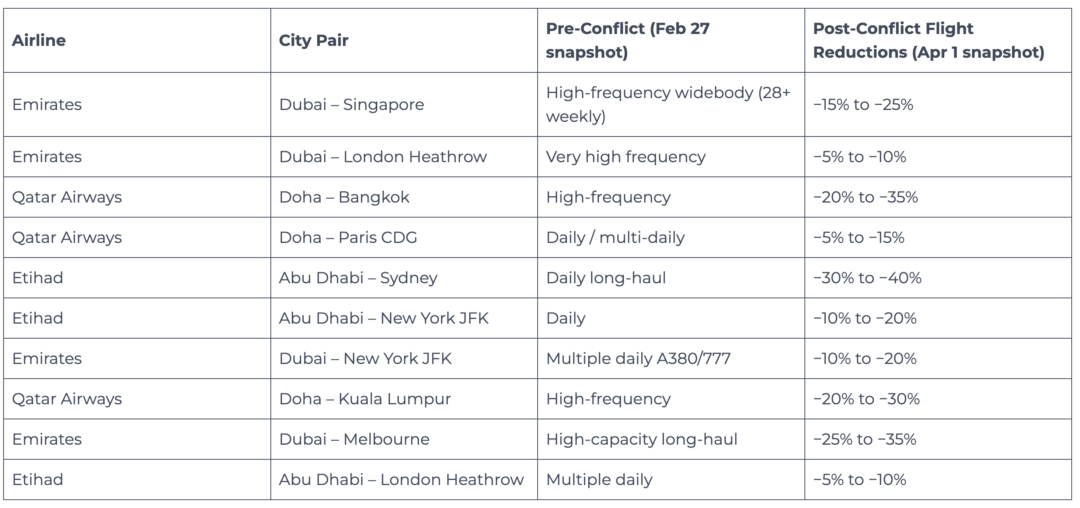
The three major Gulf carriers (Emirates, Qatar Airways, and Etihad) have drastically cut April capacity versus the pre-conflict schedule. In total, they have removed more than 5.4M seats and more than 18,000 flights for the month of April alone. The trend is likely to continue in the near term.
The post What’s happening with airlines and airports in the Gulf right now? appeared first on Air Cargo Week.
Go to Source
Author: Anastasiya Simsek
Latest Posts