
Jun 26, 2026
- Central Asia is rewriting its role in the global air cargo network, and it is doing so faster than most of the industry anticipated.
- A region long defined by landlocked geography and surface transport dependence is emerging as one of the most strategically relevant logistics corridors of the decade, positioned at the convergence of Asia, Europe and the Middle East at precisely the moment when established routes through Russia and the Gulf are under pressure.
The economic foundation is solid. The European Bank for Reconstruction and Development projects that the Central Asian economies of Kazakhstan, the Kyrgyz Republic, Mongolia, Tajikistan, Turkmenistan and Uzbekistan will grow by an average of 6.1 percent in 2025, easing to 5.2 percent in 2026. IATA air cargo market data for October 2025 showed the Europe-Asia corridor growing by 10.6 percent year-to-date, with intra-Asia flows adding 9.4 percent. The Central Asia e-commerce market reached US$14.7 billion in 2024 and is projected to reach US$182.2 billion by 2033.
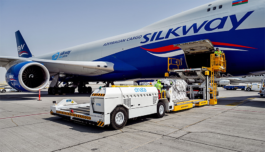
Two carriers are doing much of the work to define what this revival looks like in practice. Silk Way West Airlines, operating out of Baku, Azerbaijan, has been systematically building out its Central Asian network with a clear long-term strategy.
“Central Asia is transforming into a strategically important region in global logistics. For us, this region is not just an opportunity; it’s a core part of our long-term network strategy,” said Vugar Mammadov, vice-president of Silk Way West Airlines.
Three new Boeing 777-200F aircraft have already joined the fleet, with a fourth arriving early next year, alongside orders for four Airbus A350Fs and four Boeing 777-8Fs for delivery later this decade.
Georgian Airlines is approaching the opportunity from a different angle, positioning Georgia as a modern reincarnation of its ancient Silk Road role. “Georgian Airlines views Georgia not simply as a transit country, but as a historical and natural gateway between civilisations,” said Tsisia Phanchvidze, first deputy general director of Georgian Airlines. The carrier is working towards what it calls a single-window air logistics ecosystem, enabling customers to move cargo through Georgia with single-point coordination, faster clearance and guaranteed reliability. Its route network already reaches Italy, France, Belgium, Hungary, Romania, Israel, the UAE, Kazakhstan, China and Hong Kong, with growth driven by China-Europe flows through the Black Sea and expanding e-commerce linking the Caucasus with Turkey, the Gulf and the EU.
The cargo flowing through these corridors reflects the region’s economic complexity. e-commerce dominates growth statistics, but stable demand also exists for construction materials tied to infrastructure programmes and oil-and-gas equipment serving Azerbaijani and Central Asian markets. The origins, destinations and cargo types are all diversifying simultaneously, which is a sign of a maturing corridor rather than a single-commodity rush.
Infrastructure development is accelerating across multiple points along the route. Modern cargo terminals, customs digitalisation, cold chain capabilities and automated parcel sorting systems are all being built in parallel. Many Central Asian airports remain relatively uncongested compared to major European or Asian hubs, giving airlines operational flexibility and smoother turnaround times.
“Many Central Asian airports are still uncongested, which gives airlines more flexibility and smoother operations, a clear advantage,” Mammadov noted.
That advantage is not permanent. The investment now underway will eventually bring more capacity and more competition. The carriers and countries moving fastest to build reliable, digitally enabled, end-to-end logistics systems are those most likely to hold their position when the corridor reaches maturity.
The post Silk Road Revival in the Skies: Mapping New Air Cargo Routes Across Central Asia appeared first on Air Cargo Week.
Go to Source
Author: Anastasiya Simsek
Latest Posts