
Mar 06, 2026
- Gulf airspace disruptions are constraining global airfreight capacity. Airspace closures and restricted hub operations in the Gulf are forcing flight reroutings and suspensions, affecting roughly 12–13 percent of global airfreight capacity and redirecting cargo flows toward alternative gateways in Asia.
- Network strain is increasing transit times, costs, and volatility. Longer routings, reduced payloads, and limited freighter availability are lowering schedule reliability and pushing up operating costs, while geopolitical risks and displaced cargo are tightening capacity into Europe and North America.
- March capacity conditions are temporary and uneven. A short post–Lunar New Year window of relative capacity is emerging, but rising production in Asia, quarter-end shipping, ecommerce demand, and South American perishables exports could quickly compress capacity and create corridor-specific volatility.
Airspace restrictions across the Gulf region are disrupting one of the world’s most critical air transit corridors, limiting access to traditional east-west routings and forcing carriers to adjust schedules, reroute flights, or suspend select services.
Operations at major Gulf hubs remain closed or heavily constrained, with limited capacity prioritized for non-commercial movements, such as humanitarian relief. This has materially reduced throughput at key transit points and further constrained connectivity across the region.
Because Gulf-based carriers play a central role in global air freight networks—not only for Middle East-origin cargo, but for flows connecting Asia, South Asia, Southeast Asia, Europe, and North America—the effects extend well beyond the region itself. An estimated 12–13% of global air freight capacity has been affected by reduced Gulf operations and closed airspace.
Cargo that would typically transit through hubs such as Abu Dhabi, Doha, and Dubai is being pushed into alternate gateways across China, India, and Southeast Asia, adding friction just as freight ramps up after the Lunar New Year holiday.
Longer routings are extending transit times, reducing payloads, and lowering schedule reliability. At the same time, displaced Gulf cargo is affecting capacity into Europe and North America, tightening global air networks earlier in March than typical seasonal patterns—particularly for time-sensitive and high-value freight.
Another risk affecting routing is emerging: escalating tensions between Afghanistan and Pakistan. This situation adds more uncertainty for India-origin routings that already face airspace restrictions.
These dynamics are occurring at a time when dedicated freighter capacity remains structurally constrained. Aircraft availability remains tight, limiting the system’s ability to absorb uneven demand and reducing routing flexibility when disruptions occur. Transit times are becoming less predictable and cost pressures tied to longer routes, higher fuel burn, and elevated operating complexity are increasingly showing up in the form of surcharges and deviation-related fees.
A market shaped by timing
The early weeks of March have historically offered a brief period of post-holiday normalization, and early indicators suggest 2026 is following a similar pattern. Capacity is generally more available as freighter schedules are reinstated and production restarts unevenly across Asia. Spot rates often reflect this seasonal pause, particularly on Asia–Europe and Asia–LATAM lanes, as networks reset after the holiday period.
This window, however, is typically short lived. Production ramp-ups across Asian manufacturing centers tend to accelerate through mid-March, with some facilities increasing output to recover ground lost during the shutdown.
By late March, the overlap of quarter-end shipping activity, Easter-related ecommerce flows, and the seasonal perishables peak out of South America—including flowers, seeds, and fresh produce from Argentina, Chile, and Uruguay—may place simultaneous pressure on capacity across multiple lanes. When these drivers converge, the impact is less about a single “peak season” and more about compressed volatility, where short periods of tightness can develop quickly.
Understanding the current capacity picture
Across Europe–North America and Asia–Europe lanes, pricing has been influenced largely by the return of passenger flights, which add cargo space underneath the aircraft. As airlines prepare for their summer schedules, this additional space is beginning to factor into how the market is priced, particularly on long haul routes tied to leisure travel.
At the same time, not all air cargo capacity behaves the same way. Dedicated cargo aircraft remain in relatively short supply due to aircraft shortages and delays in freighter conversions. This limits how quickly capacity can adjust when demand rises, especially if volumes return unevenly or with little notice. As a result, availability can tighten quickly on specific routes even when overall market conditions appear balanced.
Not a surge—a snapback
This month’s most decision-relevant signal is not a broad demand surge, but how unevenly volume is re-entering the network. Air networks rarely tighten because global demand rises modestly. They tighten when concentrated flows return quickly and compete for the same routings, schedules, and gateways, or when there’s a significant disruption.
In March, the clearest example is traffic from South Asia. Overall tonnage from this origin is up 7% week over week (w/w), while South Asia–North America chargeable weight is up 12%, indicating corridor-level momentum that outpaces the broader origin trend. That divergence can limit routing and scheduling choices on specific lanes even when capacity appears ample elsewhere.
Lane-level data points to volatility rather than a smooth recovery during the late-February restart. India–North America traffic rose 14% after an 8% dip during the shutdown window, a pattern consistent with deferred shipments re-entering the market. Bangladesh–North America stood apart, increasing 17% after a prior 10% gain, indicating a more sustained two week build rather than a one-time release. These distinctions matter operationally: snapbacks often normalize once deferred volumes clear, while multiweek gains can influence how quickly capacity is allocated.
In the Middle East, cancelled flights, airports operating minimally and airspace restrictions across Iraq, Kuwait, Qatar, and parts of the broader Gulf region have added a new constraint to these lanes, further redirecting cargo flows through Indian and Asian gateways that are already normalizing post-Lunar New Year.
Europe bound movement from South Asia is positive but more moderate, up 6% w/w. The takeaway is not that one destination is tight and another soft, but that corridor specific momentum is what drives real world outcomes—shorter booking windows, fewer routing options, and brief periods of rate sensitivity—often before global averages reflect the shift.
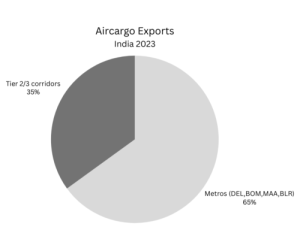
Two additional signals help contextualize this environment. India’s overall exports—goods and services combined—were up 13.17% year over year (y/y) entering 2026, reinforcing that outbound trade activity remains firm even as import growth has widened the trade deficit. In Latin America, demand for March and April is tracking at approximately 2–3% y/y growth, supported by perishables and selective technology and ecommerce flows. Neither point to a spike, but modest baseline growth can still coexist with lane specific tightness when volatility concentrates into a small set of gateways simultaneously.
When timing matters most
In the near term, trade policy developments are also influencing shipment timing, reinforcing that short-term demand patterns may reflect calendar and regulatory effects rather than a shift in underlying trade fundamentals. For more detail on what is—and is not—changing in the tariff landscape, see the Trade Policy & Customs section of this report.
The Year of the Fire Horse is traditionally associated with speed, momentum, and the need to act decisively when conditions align. In air freight terms, that does not imply constant urgency, it implies awareness of timing. March and April are shaping up to reward shippers that recognize when capacity is briefly more available, and are prepared for how quickly conditions can shift once overlapping demand cycles converge. The question is not whether the market is broadly “tight” or “soft,” but whether supply chains are positioned to move when the window is open, and protected when it closes.
The post New report reveals scale of impact of Middle East disruption appeared first on Air Cargo Week.
Go to Source
Author: Edward Hardy
Latest Posts