
Jun 17, 2026

- Global SAF production is set to reach 2.4 million tonnes in 2026, but IATA warns this will still represent just 0.8 percent of global jet fuel use.
- The association says aviation’s net-zero ambitions risk outpacing supply unless governments support SAF production, co-processing, lower-carbon aviation fuel, book-and-claim systems and energy infrastructure before imposing tougher mandates.
The aviation industry’s pathway to net zero by 2050 increasingly depends on sustainable aviation fuel (SAF), but new data from IATA suggests production remains far below the levels needed to meet future demand and regulatory requirements.
According to figures presented during IATA’s Annual General Meeting sustainability briefing, global SAF production is expected to reach 2.4 million tonnes in 2026, more than double the 1 million tonnes produced in 2024. Despite this growth, SAF will still account for only 0.8 percent of global jet fuel consumption this year.
The gap between ambition and reality is at the centre of IATA’s latest call for governments to focus on policies that expand production before introducing increasingly stringent mandates.
“The transition cannot start with the end product or the end user,” one slide note.
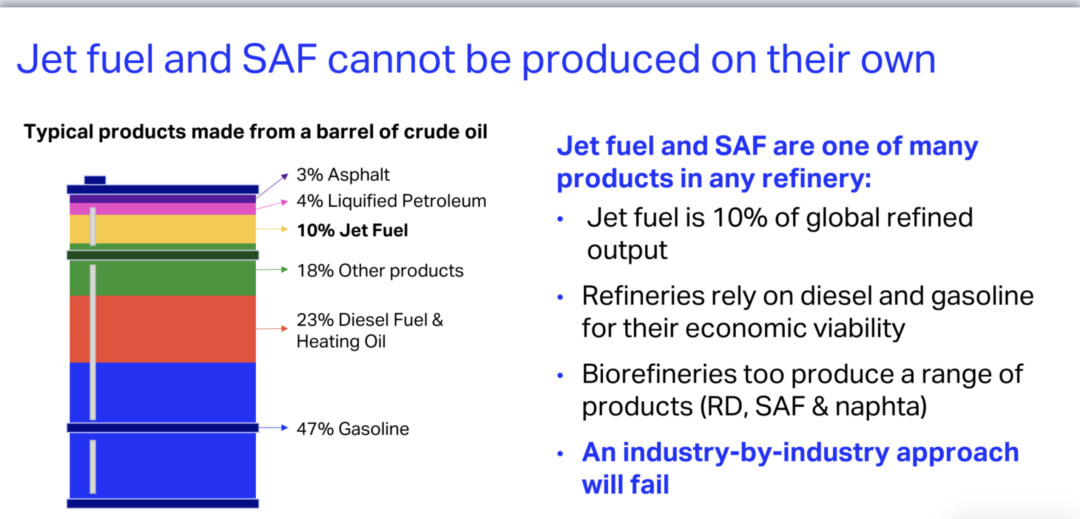
IATA’s analysis highlights the scale of the challenge facing the sector. Jet fuel represents only around 10 percent of global refined fuel output, while refineries remain economically dependent on larger-volume products such as gasoline and diesel. As a result, aviation cannot simply scale SAF production in isolation from broader energy markets.
The association also pointed to significant regional imbalances. Europe, for example, remains heavily dependent on imported jet fuel, with approximately 64 percent of its supply sourced from outside the region. Recent geopolitical disruptions in energy markets have further exposed these vulnerabilities, with regional jet fuel price differences widening from between USD 2 and USD 41 per barrel before March 2026 to as much as USD 85 per barrel afterwards.
While SAF capacity continues to expand, IATA argues that available production is unevenly distributed and, in some cases, underutilised because of persistent cost gaps. By 2030, the organisation expects global SAF capacity to reach around 20 million tonnes, with 95 percent still relying on HEFA and co-processing technologies. More advanced pathways such as alcohol-to-jet and power-to-liquid fuels are projected to account for only a small fraction of total capacity.
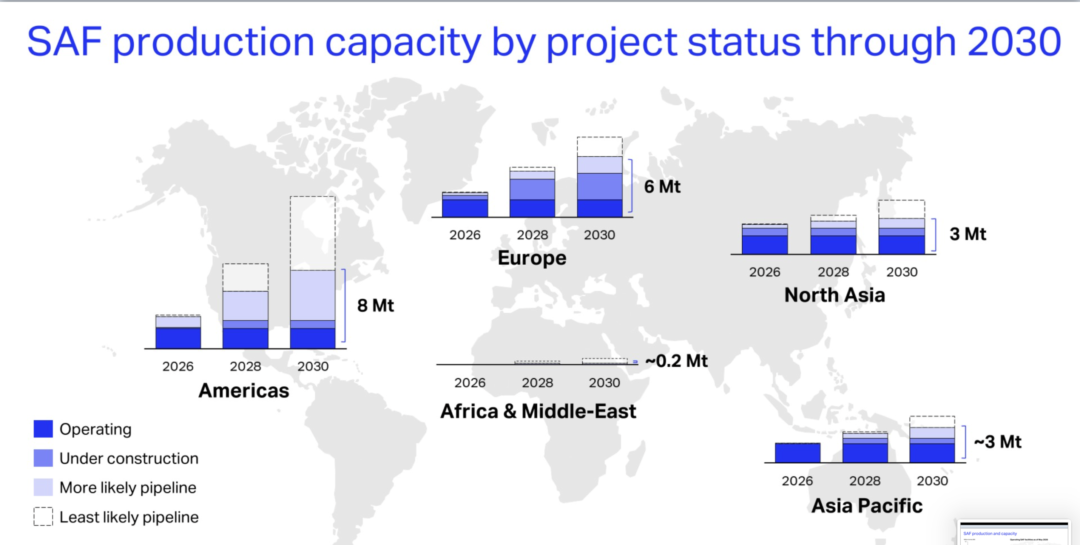
One of the industry’s biggest concerns centres on e-SAF. IATA estimates that global e-SAF capacity currently operating or under construction stands at just 0.02 million tonnes, while European and UK mandates alone could require around 0.6 million tonnes by 2030. To accelerate progress, IATA is urging policymakers to prioritise what it describes as “low-hanging fruit”, including wider use of co-processing, development of lower-carbon aviation fuel (LCAF), investment support for new technologies, and implementation of global book-and-claim systems.
IATA also estimates that co-processing alone could contribute up to 2.6 million tonnes of SAF by 2030, while LCAF could provide an additional 14 million tonnes globally under ICAO’s medium-term scenario.
The post IATA warns SAF ambitions risk outpacing supply appeared first on Air Cargo Week.
Go to Source
Author: Anastasiya Simsek
Latest Posts