
Jun 08, 2026
- Turkish Cargo is positioning Istanbul as a global hub, treating airfreight as a tightly engineered network where execution discipline across Europe–Africa lanes matters more than headline capacity. Forwarders are effectively embedded into operational delivery rather than sitting outside it.
- Digital systems now sit at the core of operations, with Smart Hub visibility turning capacity allocation into a live, data-driven process rather than static booking. Network decisions are increasingly made in real time across thousands of daily movements.
- Competition is shifting into specialised, partnership-led logistics, pharma, cold chain and time-critical flows, driven by API-linked booking and closer airline–forwarder coordination to manage volatility across emerging trade corridors.
Turkish Cargo is positioning Istanbul at the centre of global trade, connecting key trade lanes through multi-country coordination with its global partners.
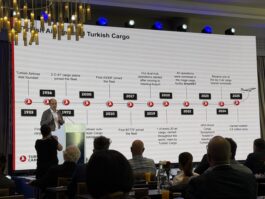
“We grew stronger, setting our sights on the next goal with brand new wings. We carried the world and raised it far higher into the skies. Thanks to smart systems, we clean the skies and make success our own,” Sarper Ozpercin, Turkish Cargo’s Cargo Director for North and West Africa, told the Neutral Air Partner’s conference in Marrakech, Morocco. “A roadmap means nothing without operational mastery. A digital entry is empty without cost control, and a contract is just paper without execution. Without these, volumes are built into our DNA today.”
Digitalisation as the new operating backbone
Turkish Cargo’s Smart Hub model reflects a shift where visibility, control and system integration are no longer supplementary tools but core infrastructure. In practical terms, this is reshaping how shipments are planned, accepted and monitored, particularly across long-haul corridors linking Europe, Africa and Asia where complexity is inherently high.
The scale of operational visibility now available is altering decision-making cycles. With thousands of flights operating within a continuously updated network environment, capacity management becomes a live function rather than a static allocation exercise. For forwarders and cargo buyers, this introduces a more fluid relationship with airline inventory, where responsiveness and data alignment matter as much as contractual space commitments.
“Digital transformation is essential for us. This system is not only about optimisation; it is also a two-way monitoring platform integrated with all our software,” Ozpercin outlined. “Turkish Cargo now operates across more countries than any other airline in terms of wide-body cargo capacity. We deliver shipments globally, supported by a large-scale fleet and extensive flight network. At any given time, there are over 1,400 flights operating.”
Specialisation, partnerships and the shifting geography of demand
The next phase of airfreight competition is being shaped by product differentiation and deeper collaboration with forwarders operating across emerging manufacturing corridors. Specialised handling for pharmaceuticals, temperature-sensitive cargo and time-critical flows is becoming central to network design rather than an adjacent service layer. This is particularly relevant for North and West Africa, where export diversification is accelerating and reliability expectations are tightening.
At the same time, digital integration through APIs and booking platforms is reducing friction in how capacity is accessed and managed. The commercial relationship is evolving from transactional booking behaviour into co-developed network planning, where demand signals and capacity decisions are increasingly synchronised. This shift also reflects a broader industry move towards predictability over opportunistic uplift.
“Looking ahead, we are strengthening partnership through three key areas. First is digital integration. We are investing in API connections and the TKO system, a smart booking platform enabling seamless access across devices and platforms,” Ozpercin explained. “As we meet here in Marrakesh, the handshakes we exchange and the collaboration we begin over the next few days will set the trajectory for years to come. We are fully committed to building a strong community based on capability, expertise, and shared vision. We invite you to challenge us.”
The post Connecting the world through Istanbul appeared first on Air Cargo Week.
Go to Source
Author: Edward Hardy
Latest Posts