

Apr 09, 2026

- Global air freight rates are rising again, with market volatility increasingly shaped by geopolitical disruption rather than traditional seasonal demand patterns.
- The latest data from TAC Index shows a sharp upward movement in pricing, as the ongoing conflict in the Middle East continues to constrain capacity and push up operating costs across key trade lanes.
- The global Baltic Air Freight Index (BAI00) rose by +5.1% in the week to April 6, leaving it up +15.8% year-on-year.
The increase reflects a market under pressure from elevated jet fuel prices and tightening supply in certain regions — conditions that, according to market sources, are unlikely to ease quickly even in the event of a near-term de-escalation.
What is notable in the current cycle is not simply the scale of rate increases, but the underlying drivers. Rather than peak season demand or e-commerce surges, pricing is being shaped by external shocks — in this case, instability in the Gulf region, which remains a critical node in global air cargo networks.
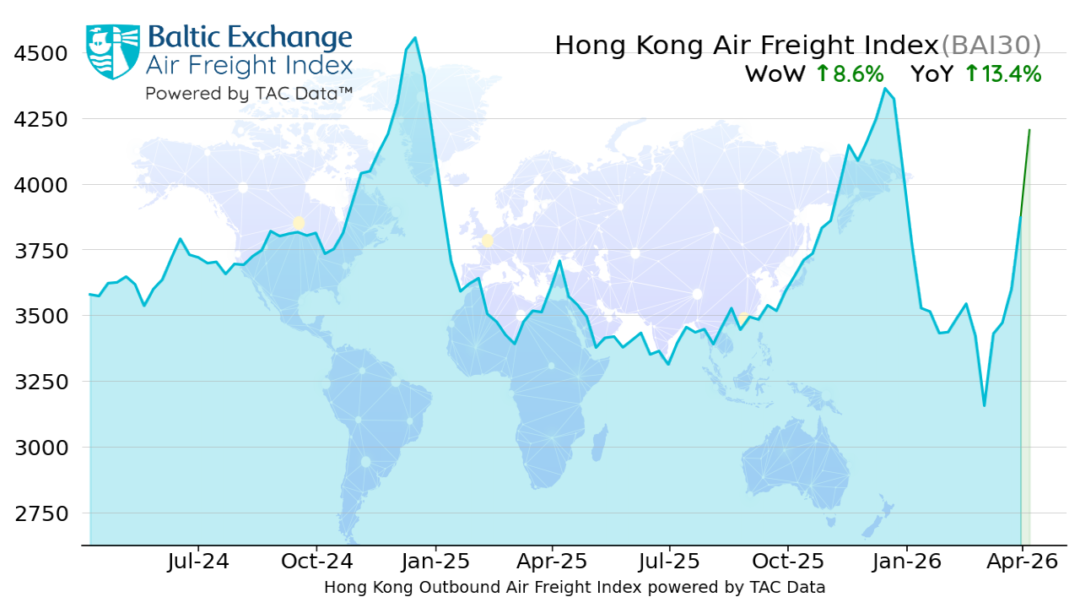
The disruption is already visible in pricing behaviour across Asia. Rates on major eastbound and westbound corridors out of China — the backbone of global air freight — rose again week-on-week, leaving them up by almost +30% year-on-year in both directions. Outbound Hong Kong (BAI30) climbed +8.6% week-on-week, now standing at +13.4% above last year’s levels, while Shanghai (BAI80) increased +6.4% week-on-week to reach +21.3% year-on-year growth.
Similar upward pressure is evident across Southeast Asia. Lanes from Bangkok and Vietnam recorded further weekly gains, reinforcing the sense that capacity constraints are not confined to a single origin but are spreading across the broader Asia-Pacific region.
India has emerged as a particularly reactive market. Spot rates from the country have surged since the outbreak of conflict in the Gulf, with overall indices for outbound routes to both Europe and the US continuing to rise week-on-week. The speed of that response highlights how closely connected pricing dynamics remain to geopolitical developments affecting key transit regions.
In contrast, rate movements from Europe and North America were more mixed, suggesting that while global pricing is rising, regional dynamics remain uneven.
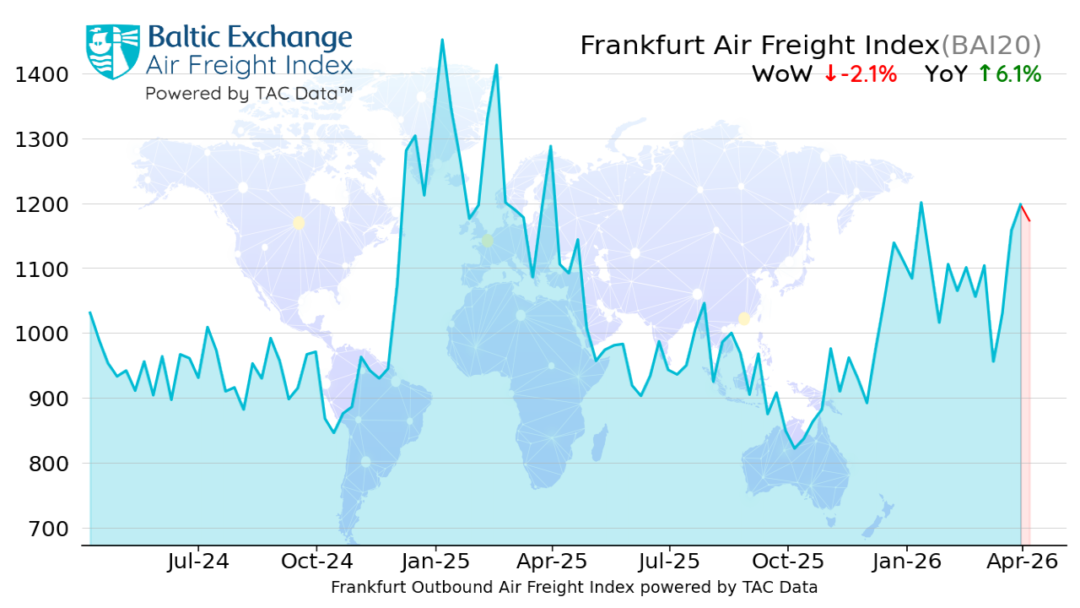
From Europe, gains on certain lanes — including transatlantic routes to the US and connections to Japan, Brazil, South Africa and the UAE — were offset by declines on others, notably to China, India, Mexico and Australia. The index of outbound routes from Frankfurt (BAI20) fell by -2.1% week-on-week, though still remains +6.1% higher year-on-year.
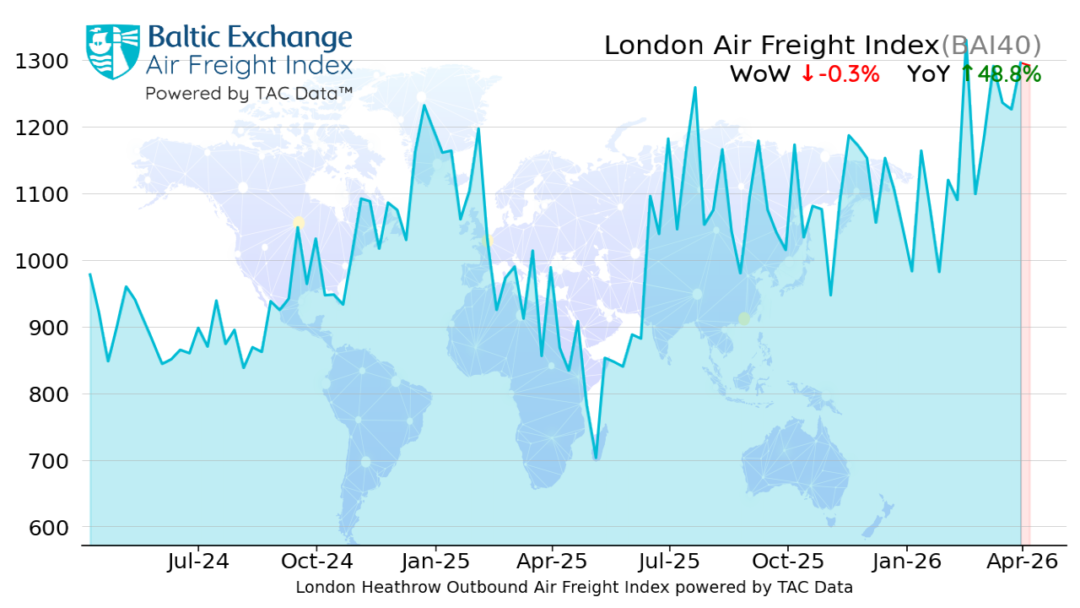
London Heathrow (BAI40) showed a similar pattern, dipping slightly by -0.3% week-on-week. However, this follows a period of strong upward movement, leaving rates from the UK hub significantly elevated at +48.8% year-on-year — one of the most pronounced increases among major gateways.
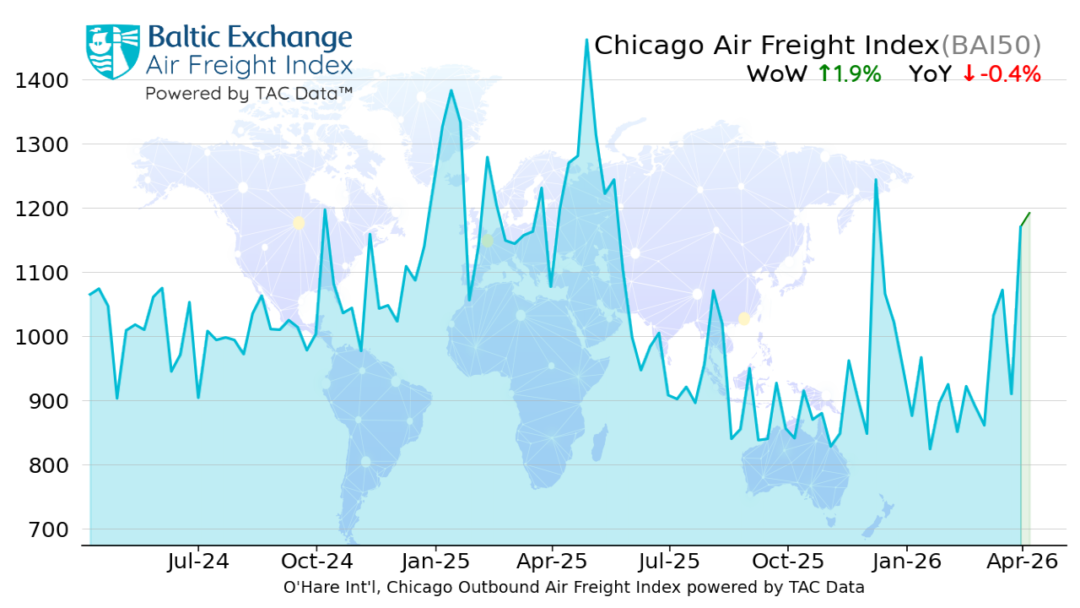
From the United States, pricing trends were also fragmented. Rates declined modestly on lanes to Europe and China, while increasing on routes to South America, the UK and South Korea. The Chicago index (BAI50) rose +1.9% week-on-week, though remains marginally down year-on-year at -0.4%, underlining the relative instability of transpacific and transatlantic flows.
Mexico, meanwhile, continues to see strong upward pressure, with rates to Europe rising again week-on-week and remaining well above last year’s levels.
The broader picture is one of a market where multiple pressures are converging. Elevated jet fuel costs are feeding directly into rate structures, while disruptions linked to the Middle East are constraining available capacity — either through operational adjustments or reduced network flexibility.
The post Airfreight rates climb as Middle East disruption tightens supply appeared first on Air Cargo Week.
Go to Source
Author: Anastasiya Simsek
Latest Posts