
Aug 19, 2026
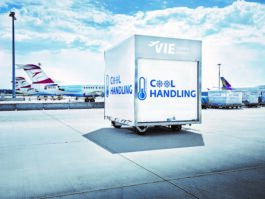
- Cargo volume at Vienna Airport remained stable at a high level in the first half of 2026
- From January to June, a total of 154,276 tonnes of cargo (air cargo and trucking) were handled at Vienna Airport, representing a slight year-on-year increase of 0.2%.
- Pharmaceutical cargo recorded particularly strong growth, rising by 22.4% to 2,497 tonnes.
- In July 2026, cargo volume totalled 28,013 tonnes, down slightly by 0.3% compared with the same month of the previous year. From January to July, cargo volume increased by 0.1% to 182,289 tonnes.
- This July, pharmaceutical cargo reached 479 tonnes, representing a decline of 1.7 percent
“Despite a challenging market environment characterised by high operating costs, the airport charge reduction introduced on 1 January 2026, a reduced low-cost carrier offering in Vienna, and flight cancellations linked to the conflict in the Middle East, the Flughafen Wien Group delivered a solid performance in the first half of 2026.
Supported by a rigorous cost-saving programme, strong growth at Malta and Kosice airports, and positive one-off effects, EBITDA increased by 7.3 percent to €227.1 million, while EBIT rose by 9.1 percent to €159.4 million, despite revenue growth of just 0.9 percent. Group net profit before non-controlling interests increased by 7.0 percent to €123.2 million.
Capital expenditure in Vienna and Malta rose significantly to €150.8 million. Our largest investment project, the Terminal 3 Southern Expansion, remains on schedule and within budget and is expected to enter operation in the second quarter of 2027 as planned.
Based on current performance, we are also able to slightly improve our financial guidance for 2026. However, Austria is losing ground as an aviation location in international comparison, as reflected in recent developments across the Austrian airline and airport sector. The same challenge applies to Europe as a whole when compared with major growth markets such as China, India and the United States.
If Europe and Austria are to remain competitive, urgent reforms are needed. These include changes to EU aviation regulations that distort competition, simpler administrative procedures for infrastructure projects, and a much stronger focus on growth and innovation,” said Günther Ofner, Joint CEO and CFO of Vienna Airport.
Strategic investments drive growth while Vienna Airport faces headwinds – action needed to strengthen Austria’s aviation competitiveness
“Traffic performance in the first half of 2026 was mixed. Passenger volumes across the Flughafen Wien Group increased by 1.9 percent, driven by strong growth at Malta Airport, where traffic rose by 15.6 percent, and Kosice Airport, which recorded growth of 43.5 percent.
By contrast, passenger traffic at Vienna Airport declined by 3.2 percent due to the reduced low-cost carrier offering and the continuing impact of the conflict in the Middle East. Although this trend continued into July 2026, traffic performance has been less negative than anticipated at the start of the year.
As a result, we are able to slightly increase our full-year passenger forecast to 30.5 million passengers at Vienna Airport and 42.5 million passengers across the Flughafen Wien Group, including Malta and Kosice.
However, if Austria is to achieve sustainable growth as an aviation hub once again, it urgently needs a regulatory framework that enhances international competitiveness and supports expansion. The €60 million support package for the aviation sector announced by the Federal Ministry for Innovation, Mobility and Infrastructure (BMIMI) over the next two years is an important first step. Nevertheless, it falls well short of what is required, and further measures are urgently needed.
The highest priority should be the abolition of the air transport levy, or at the very least a substantial reduction. Growth is increasingly taking place in markets where such burdens do not exist, as demonstrated by the strong performance of airports in our neighbouring countries to the east,” said Julian Jäger, Joint CEO and COO of Vienna Airport.
January to June 2026: 14.3 million passengers at Vienna Airport; 20.0 million across the Flughafen Wien Group
Total passenger volume across the Flughafen Wien Group, comprising Vienna Airport and its strategic investments in Malta Airport and Kosice Airport, increased by 1.9 percent year on year to 19,975,392 passengers in the first half of 2026.
Vienna Airport handled 14,267,744 passengers during the period, representing a decline of 3.2 percent compared with the same period in 2025.
The number of flight movements at Vienna Airport rose by 4.6 percent to 107,709 take-offs and landings. The average seat load factor increased by 1.7 percentage points to 79.3 percent.
Cargo volumes, including air cargo and trucking, rose slightly by 0.2 percent to 154,276 tonnes. Medical cargo performed particularly strongly, increasing by 22.4 percent to 2,497 tonnes.
Malta Airport reported strong growth, handling 5,247,403 passengers in the first half of 2026, up 15.6 percent. Kosice Airport also recorded significant growth, with passenger traffic increasing by 43.5 percent to 460,245 travellers.
H1 2026: Revenue rises to €529.3 million and Group net profit increases to €123.2 million
The Flughafen Wien Group generated revenue of €529.3 million in the first half of 2026, an increase of 0.9 percent compared with €524.4 million in the same period of 2025.
EBITDA rose by 7.3 percent to €227.1 million, compared with €211.7 million in the prior-year period, while EBIT increased by 9.1 percent to €159.4 million from €146.1 million.
Group net profit before non-controlling interests increased by 7.0 percent to €123.2 million, compared with €115.1 million in the first half of 2025.
The improvement in earnings was primarily driven by lower operating expenses resulting from the Group’s cost-saving measures.
Cash flow from operating activities declined to €147.0 million from €157.1 million in the prior-year period, mainly due to higher tax payments and reductions in liabilities and provisions.
Revenue and earnings by segment
The Airport Segment generated revenue of €231.2 million and EBIT of €60.6 million during the first half of 2026.
The Handling and Security Services Segment increased revenue to €103.1 million and recorded EBIT of €3.7 million. This segment includes the security services provided by VIAS as well as handling services delivered by Vienna Airport FBO (VAF) and Vienna Passenger Handling Services (VPHS).
The Retail & Properties Segment generated revenue of €101.4 million and EBIT of €47.5 million.
The Malta Segment reported revenue of €82.5 million and EBIT of €42.8 million in the first six months of 2026.
Capital expenditure
The Flughafen Wien Group invested a total of €150.8 million in intangible assets, property, plant and equipment, investment property, and advance payments during the first half of 2026.
The largest investment project was the Terminal 3 Southern Expansion at Vienna Airport, which accounted for €59.6 million of expenditure. Malta Airport invested a further €24.8 million during the period.
Passenger outlook for 2026 raised slightly
For the full year 2026, Flughafen Wien AG now expects approximately 42.5 million passengers across the Flughafen Wien Group, including Malta Airport and Kosice Airport, supported by continued strong growth at both locations.
Passenger traffic at Vienna Airport is expected to reach approximately 30.5 million travellers.
Financial guidance for 2026 improved slightly
The Flughafen Wien Group now expects full-year revenue of approximately €1.08 billion in 2026, EBITDA of around €425 million, and Group net profit before non-controlling interests of approximately €220 million. Net profit after non-controlling interests is expected to reach around €190 million.
Total capital expenditure is forecast at approximately €330 million for the year.
The current traffic outlook and financial guidance assume there will be no further significant geopolitical disruptions or major restrictions on air traffic.
July 2026 traffic performance: Vienna declines, Malta and Kosice continue to grow
In July 2026, the Flughafen Wien Group handled a total of 4,470,740 passengers, an increase of 0.4 percent compared with July 2025.
Malta Airport recorded passenger growth of 14.7 percent to 1,187,590 travellers, while Kosice Airport increased traffic by 16.9 percent to 154,974 passengers.
Vienna Airport: 3.1 million passengers in July 2026
Vienna Airport handled 3,128,176 passengers in July 2026, representing a year-on-year decline of 4.7 percent.
Local passenger traffic fell by 5.3 percent to 2,400,287 travellers, while transfer passenger traffic declined by 1.2 percent to 714,482.
Flight movements decreased by 4.1 percent to 21,991 take-offs and landings. The seat load factor remained broadly stable at 84.2 percent, down just 0.2 percentage points compared with July 2025.
Cargo volumes totalled 28,013 tonnes, a slight decline of 0.3 percent year on year.
By destination region, passenger traffic from Vienna Airport in July 2026 developed as follows:
Western Europe: 1,105,488 passengers (-1.0 percent)
Eastern Europe: 267,065 passengers (-16.4 percent)
North America: 55,116 passengers (-3.0 percent)
Africa: 35,859 passengers (+6.6 percent)
Middle East: 67,176 passengers (-2.4 percent)
Far East: 72,014 passengers (+10.9 percent)
January to July 2026: Vienna Airport down 3.5 percent; Flughafen Wien Group up 1.6 percent
Between January and July 2026, Vienna Airport handled a total of 17,395,920 passengers, representing a decline of 3.5 percent compared with the same period of the previous year.
Cargo volumes increased slightly by 0.1 percent to 182,289 tonnes.
Across the entire Flughafen Wien Group, including Vienna Airport, Malta Airport and Kosice Airport, passenger traffic increased by 1.6 percent to 24,446,132 travellers during the first seven months of 2026.
The post Vienna Airport Group Delivers Solid Performance Despite Challenging Market Conditions appeared first on Air Cargo Week.
Go to Source
Author: Edward Hardy
Latest Posts