
Aug 16, 2026

- Airfreight resilience is increasingly being driven by scheduled network structures rather than reactive charter operations, allowing operators such as Magma Aviation to maintain stable performance and absorb disruptions through network adjustments rather than ad hoc capacity deployment.
- Demand remains strong but is becoming more fragmented and less predictable, with e-commerce growth, tariff changes and shifting manufacturing patterns driving rapid changes in trade flows and increasing the importance of flexible capacity allocation across emerging and established corridors.
- Aircraft availability has become a major structural constraint, as delayed freighter conversions, certification bottlenecks and OEM production issues limit new capacity, forcing operators to rely on lease extensions, prolonged aircraft utilisation and conversion programmes to meet growing demand.
Airfreight is increasingly defined by structure rather than reaction. The old cycle of charter-led responsiveness to passenger belly capacity swings has not disappeared, but it has been subordinated to scheduled networks that prioritise continuity over opportunism. That shift is quietly changing how resilience is measured across the sector.
For operators with a built-in scheduled backbone, disruption is no longer a binary shock event. It becomes a routing adjustment exercise, absorbed through network design rather than ad hoc deployment. In practice, this reduces exposure to volatile corridors while preserving baseline utilisation even when parts of the map become inaccessible.
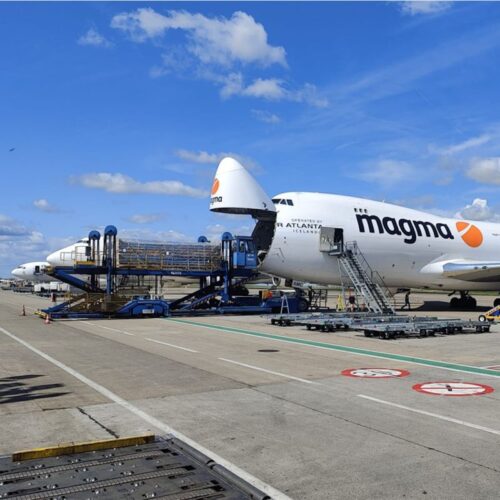
Magma Aviation has leaned into that structure, treating charter activity as a complement rather than a core dependency.
“80 percent of our flights are scheduled and they do not touch the Middle East. We had a few diversions because we come in through Dubai during the conflict, but we still ran the same schedules. We are not like other charter operators in that sense,” Peter Kerins, CEO of Magma Aviation, said.
Performance stability has followed that discipline. Even when specific lanes became more complex to operate, the underlying programme continued to deliver consistent output, with charter flows shifting rather than collapsing.
“Despite geopolitical and operational disruption, the first half of the year has been exceptionally strong for us. The scheduled structure has given us continuity and supported year-on-year performance. While some charter routes were affected, overall volumes remained stable and resilient,” he continued.
 Demand fragmentation and the re-routing of growth
The most notable change in air cargo is not simply strength of demand, but its redistribution. Utilisation levels have moved ahead of budget expectations, yet the shape of that demand is far less predictable than in previous cycles. Tariff shifts out of Asia, alongside broader industrial repositioning, are introducing short-cycle volatility that forces constant recalibration of capacity deployment.
Traditional seasonality is also fading as a reliable planning anchor. Instead of distinct peak periods, operators are dealing with a more continuous flow environment, shaped by e-commerce expansion, sourcing diversification and evolving manufacturing footprints. This compresses decision-making timelines and places greater emphasis on real-time optimisation rather than forward scheduling assumptions.
Within that environment, growth is increasingly defined by corridor flexibility rather than route heritage. Emerging links between Asia and Africa are becoming more material, while some established Asia-to-Europe flows have softened, forcing a rebalancing of aircraft deployment strategies.
“The first half of the year has been spectacular for us. Utilisation has been above budget, which is very strong. The market keeps shifting, and changes such as tariffs out of Asia can have an impact on flows,” Kerins outlined. “That includes steady streams on Africa and US flights, and we have also introduced new Asia-to-Africa services linked to e-commerce, which have been successful. We review capacity weekly to decide where aircraft should be placed. If there is a gap of around 28 hours on a tail, we look for the best market to maximise utilisation.”
Structural aircraft scarcity and the conversion bridge
If demand is fluid, supply is constrained. Across the freighter market, the binding constraint is not volume of activity but aircraft availability. Conversion programmes are delayed, certification timelines are extended, and OEM production bottlenecks are slowing the flow of new capacity into the system. The result is a persistent imbalance between demand growth and usable lift.
 This has created a second-order effect across leasing and fleet planning. Aircraft are being retained longer, lease extensions are becoming more common, and expected retirement cycles are slipping. What was once a transitional fleet phase has become a prolonged holding pattern, with limited near-term relief visible in narrowbody freighter supply.
The consequence is a market where capacity expansion is structurally lagging demand, forcing operators to bridge gaps through a combination of conversions and extended asset utilisation rather than clean fleet renewal.
“It is a perfect storm at the moment because conversions are not happening as quickly as they should and certification is also delayed. We know about the production delays at Boeing and Airbus, and people are holding on to aircraft for longer. This is a challenge for the entire supply chain,” Kerins expressed.
At the same time, conversion strategies remain central to medium-term flexibility, even if constrained by feedstock availability. The economics and efficiency gains of newer converted platforms are becoming clearer, but access to suitable aircraft is increasingly the limiting factor rather than technical capability.
“We have looked at all conversion houses and are in discussions with several parties. The triple seven conversions are different and are starting to show efficiencies, but feedstock is the real issue. Aircraft that would have been converted are staying in fleets, and that delays entry into service,” he concluded.
The post Magma bets on structure appeared first on Air Cargo Week.
Go to Source
Author: Edward Hardy
Latest Posts