

Jun 17, 2026

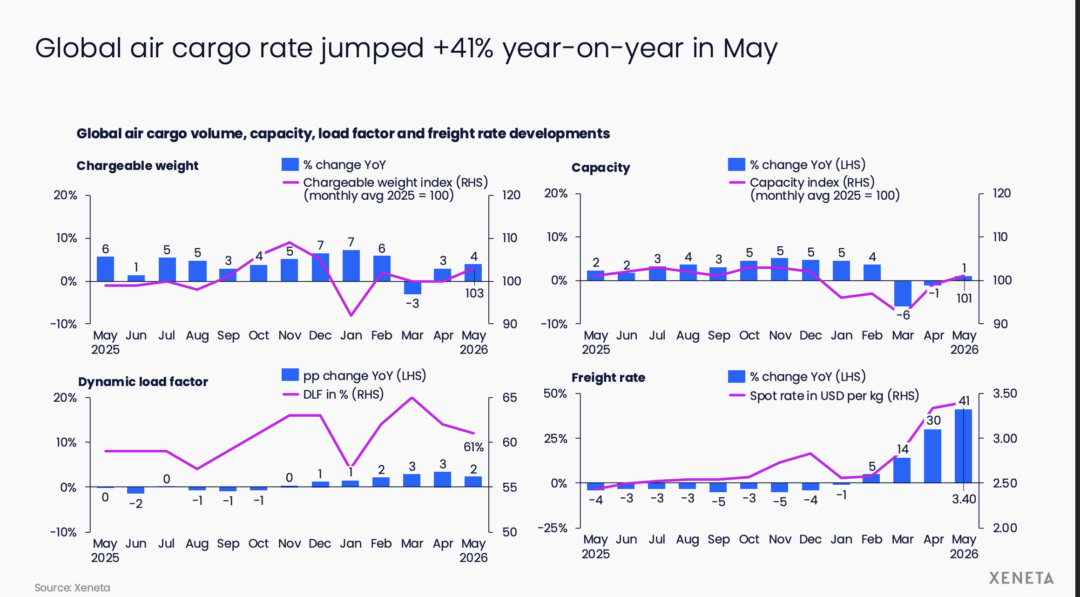
- Global air cargo rates rose 41 percent year-on-year in May 2026 as capacity constraints linked to ongoing Middle East disruption continued to support pricing, according to Xeneta.
- While Gulf-region capacity has partially recovered, strong demand from the semiconductor and AI sectors is emerging as a major market driver, pushing transpacific rates higher and keeping Asia outbound load factors near record levels.
- At the same time, Chinese cross-border e-commerce exports continue to decline following regulatory changes in the US and increased scrutiny in Europe.
The air cargo market has spent much of the past decade adapting to disruption. From the pandemic and supply chain crises to geopolitical tensions and shifting trade policies, volatility has become a constant. Yet even against that backdrop, recent developments have surprised many observers. According to Xeneta’s latest market analysis, global air cargo spot rates were 41 percent higher in May 2026 than a year earlier, despite cargo volumes increasing by only four percent and available capacity rising by just one percent. The figures illustrate a market where supply remains constrained and geopolitical disruption continues to shape pricing dynamics.
Speaking during Xeneta’s quarterly air freight webinar, Chief Airfreight Officer Niall van de Wouw highlighted just how unexpected the market shift has been.
“This was unconceivable only three months ago. The impact of the war in the Middle East…I would call it a wave effect actually, if it’s by that amount,” said Niall van de Wouw.
The primary catalyst remains the ongoing instability in the Middle East. While capacity has gradually returned to the market following the disruption that began at the end of February, recovery remains incomplete. Xeneta data shows Gulf-region freighter capacity had recovered to around 71 percent of pre-crisis levels by late May, while widebody passenger capacity had reached 66 percent. Overall capacity across the Gulf stood at approximately 70 percent of normal levels.
However, TIACA Director General Glyn Hughes argued that the figures also demonstrate the industry’s ability to adapt under pressure:“The resilience of the industry really stands out here.”
Hughes noted that the disruption affected a region responsible for around 80 percent of India-Europe air cargo and between 25 and 30 percent of China and Southeast Asia-Europe flows, making the speed of recovery particularly notable.
Semiconductors become the market’s strongest driver
While geopolitical disruption continues to influence capacity and pricing, the webinar suggested a much bigger structural shift may now be taking place.
For much of 2024 and 2025, cross-border e-commerce dominated air cargo demand. Today, however, the industry’s strongest growth engine appears to be artificial intelligence and semiconductor production.
“The single best performing vertical in airfreight at the moment is everything to do with semiconductors and these hyperscalers,” said Van de Wouw.
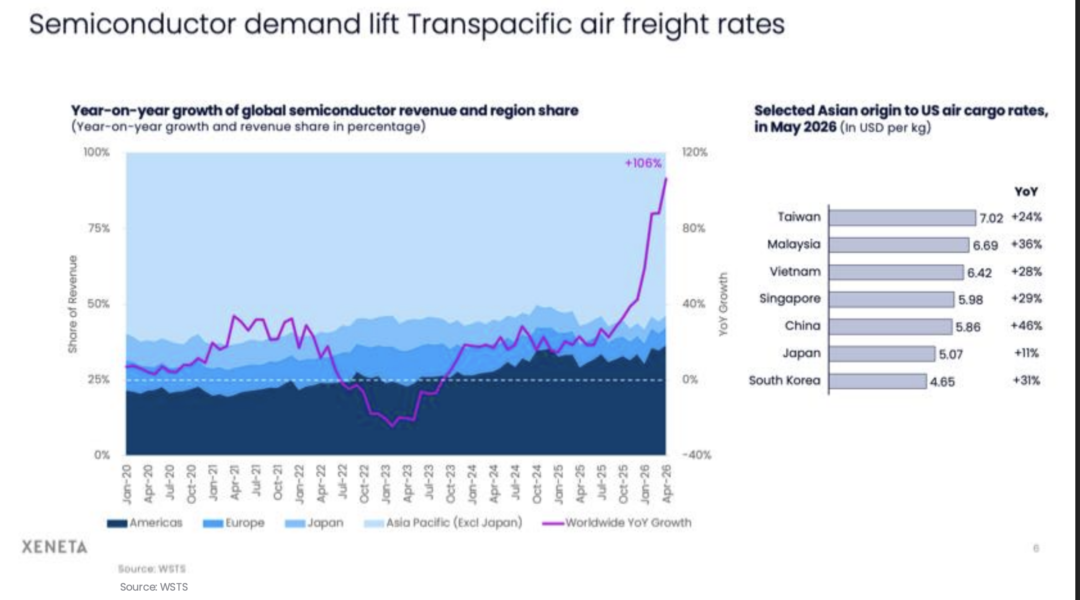
The rapid expansion of AI infrastructure is generating unprecedented demand for advanced chips, servers and data-centre equipment. Data presented by Xeneta showed global semiconductor revenues growing by more than 100 percent year-on-year, while air cargo rates from major Asian semiconductor hubs to the United States have risen sharply.
Taiwan-US rates reached $7.02 per kilogram in May, up 24 percent year-on-year. Malaysia-US rates rose 36 percent to $6.69 per kilogram, while China-US rates climbed 46 percent to $5.86 per kilogram. Similar increases were recorded from Vietnam, Singapore, Japan and South Korea.
The strength of semiconductor demand is also reflected in aircraft utilisation.
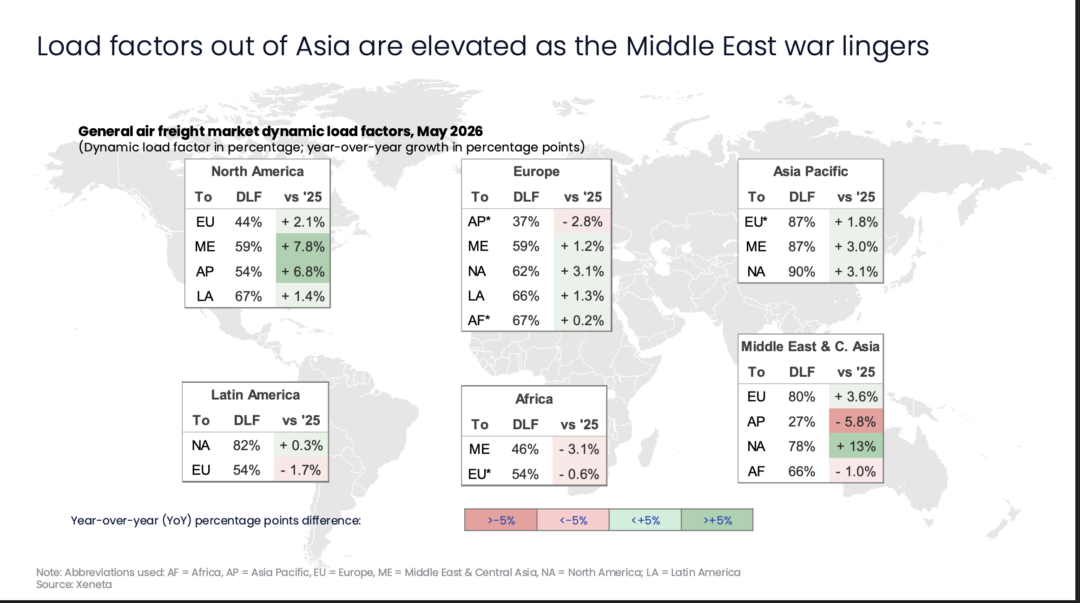
Dynamic load factors reached 90 percent on Asia Pacific-North America services and 87 percent on routes from Asia to both Europe and the Middle East.
Glyn Hughes described these figures as effectively the practical ceiling for the industry. “Flights are, I would say, very, very full from Asia Pacific to North America and to Europe.”
Such high utilisation leaves little spare capacity in the market, helping to sustain elevated rate levels despite modest overall demand growth.
e-commerce loses momentum
At the same time, the market’s previous growth engine is slowing. Chinese cross-border B2C e-commerce exports declined 11 percent year-on-year in April, including a 33 percent drop in shipments to the United States. Exports to Europe were down six percent.
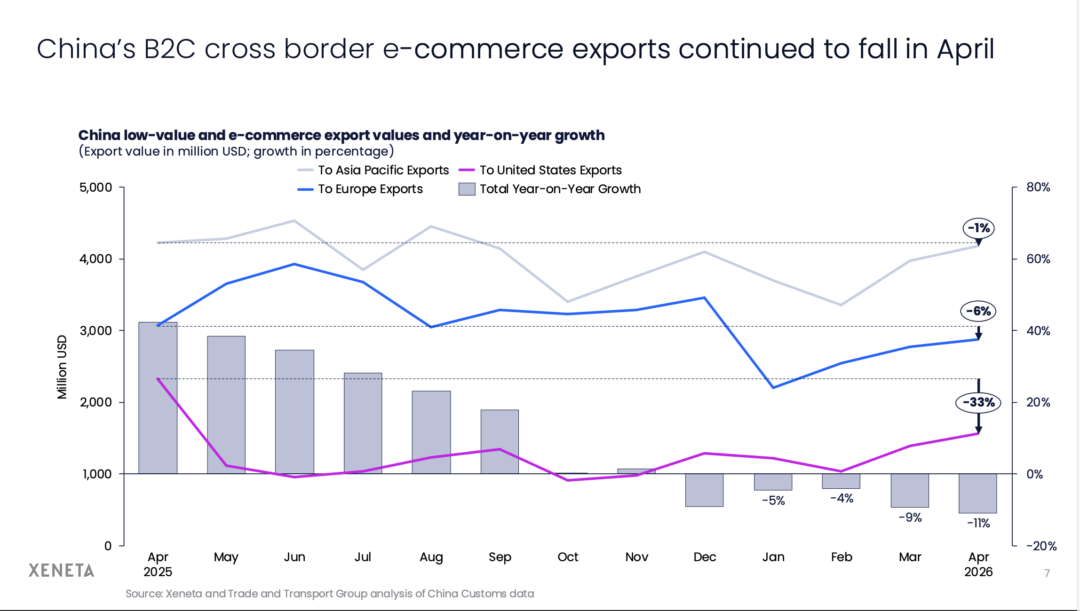
The decline follows regulatory changes in the United States and growing scrutiny of low-value imports globally.
While e-commerce remains a major source of cargo volume, van de Wouw said it is no longer exerting the same upward pressure on freight rates.
“The e-commerce volumes, and more importantly, the growth pushing up air freight rates, that is not something we’re seeing, or have been seeing for at least six months from now.”
The webinar also highlighted how uncertainty continues to affect commercial behaviour.
According to Xeneta, 51 percent of airline-forwarder agreements are now effectively spot deals with validity periods of less than one month, while longer-term contracts have become less common.
Van de Wouw explained that rapid market changes have made it increasingly difficult for buyers and sellers to commit to fixed rates.
“There’s a lot more wheeling and dealing taking place than what we saw last year,” he said.
Despite ongoing geopolitical risks, Xeneta’s outlook for the remainder of 2026 is more balanced than many expected.
The company forecasts global air cargo demand growth of two to three percent this year, broadly matching expected capacity growth of two to three percent.
While rates are unlikely to continue rising at the extraordinary pace seen in recent months, the market appears set to remain relatively tight.
And while e-commerce remains important, the webinar’s central message was clear. Air cargo’s next phase of growth is increasingly being driven by AI infrastructure, semiconductors and data-centre investment rather than low-value online retail shipments.
“Cargo is all about volatility, it’s reacting to what happens in the world,” mentioned Hughes.
The post AI overtakes e-commerce as air cargo’s new growth engine appeared first on Air Cargo Week.
Go to Source
Author: Anastasiya Simsek
Latest Posts