

Mar 23, 2026
- Lithium batteries have become routine cargo. They are also becoming one of the industry’s most persistent safety risks.
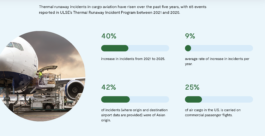
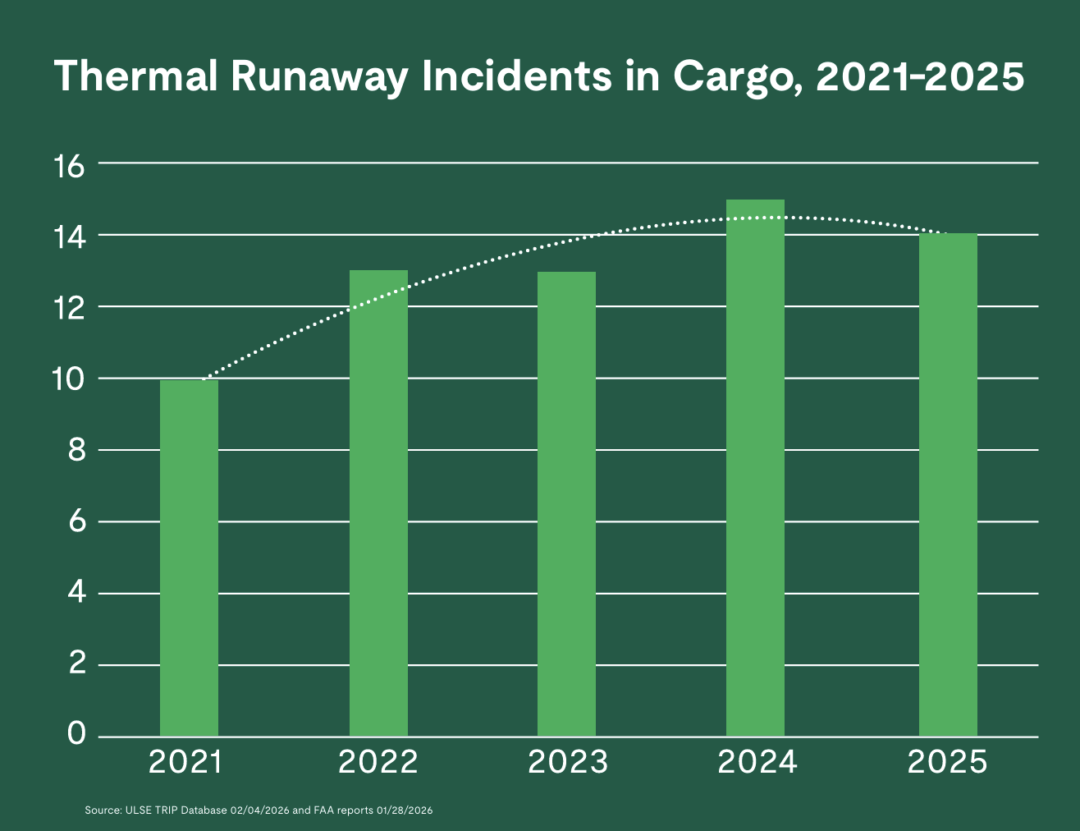
- New data from UL Standards & Engagement shows that reported thermal runaway incidents in air cargo rose by 40 percent between 2021 and 2025 — a trend that reflects not only rising volumes, but deeper structural weaknesses in how these shipments move through the global supply chain .
The issue is no longer simply about dangerous goods compliance. It is about a system struggling to keep pace with the scale, speed and fragmentation of modern logistics — particularly as e-commerce continues to drive unprecedented volumes of battery-powered products into air cargo networks.
Lithium batteries are embedded in everyday consumer goods, from phones and laptops to power banks and household devices, making them fundamentally different from traditional hazardous materials. They move in vast quantities, often through complex, multi-layered supply chains that are difficult to monitor end-to-end.
“Lithium batteries, particularly lithium-ion batteries, are a routine part of global air cargo — and an increasingly urgent safety risk. Driven by consumer demand for low-cost, battery-powered products, reported thermal runaway incidents in air cargo rose 40 percent between 2021 and 2025, according to data from UL Standards & Engagement’s Thermal Runaway Incident Program (TRIP).”
The rise in incidents is closely tied to the rapid expansion of e-commerce supply chains, where high volumes of low-cost electronics are moving at speed through increasingly fragmented logistics networks — often with limited oversight at origin.
According to the report, 65 thermal runaway incidents were recorded between 2021 and 2025, with an average annual increase of nine percent . The growth is closely tied to consumer demand for low-cost electronics, which continues to push higher volumes — and more variability — into cargo systems.
The challenge is compounded by inconsistencies in packaging, labelling and handling practices. Even where regulations exist, compliance is uneven, and enforcement fragmented across jurisdictions.
At the centre of the issue is a growing mismatch between responsibility and visibility. Airlines remain ultimately accountable for the safe transport of dangerous goods, yet often have limited ability to verify what they are carrying. They rely heavily on declarations, documentation and upstream compliance — factors that are increasingly unreliable in a fragmented supply chain.
This dynamic is particularly acute with lithium batteries, where shipments may pass through multiple intermediaries — manufacturers, consolidators, freight forwarders and e-commerce platforms — before reaching an aircraft. At each stage, oversight can weaken, and errors or non-compliance can be introduced.
The result is a system where accountability is diffuse. When incidents occur, responsibility is often pushed upstream or downstream, rather than clearly assigned.
Quality and behaviour drive risk
The report identifies two primary drivers of risk: battery quality and shipper behaviour.
Non-conforming batteries — particularly those produced outside recognised safety standards — introduce a higher likelihood of failure. At the same time, small and individual shippers often lack the expertise to correctly classify, package or declare shipments.
In many cases, they do not recognise lithium batteries as dangerous goods at all. This leads to mislabelling, incomplete documentation and improper packaging — all of which increase the risk of thermal runaway.
Commercial pressure plays a central role. Lower-cost products and faster delivery expectations incentivise shortcuts, particularly among smaller players operating at scale through e-commerce platforms.
Geography and fragmentation
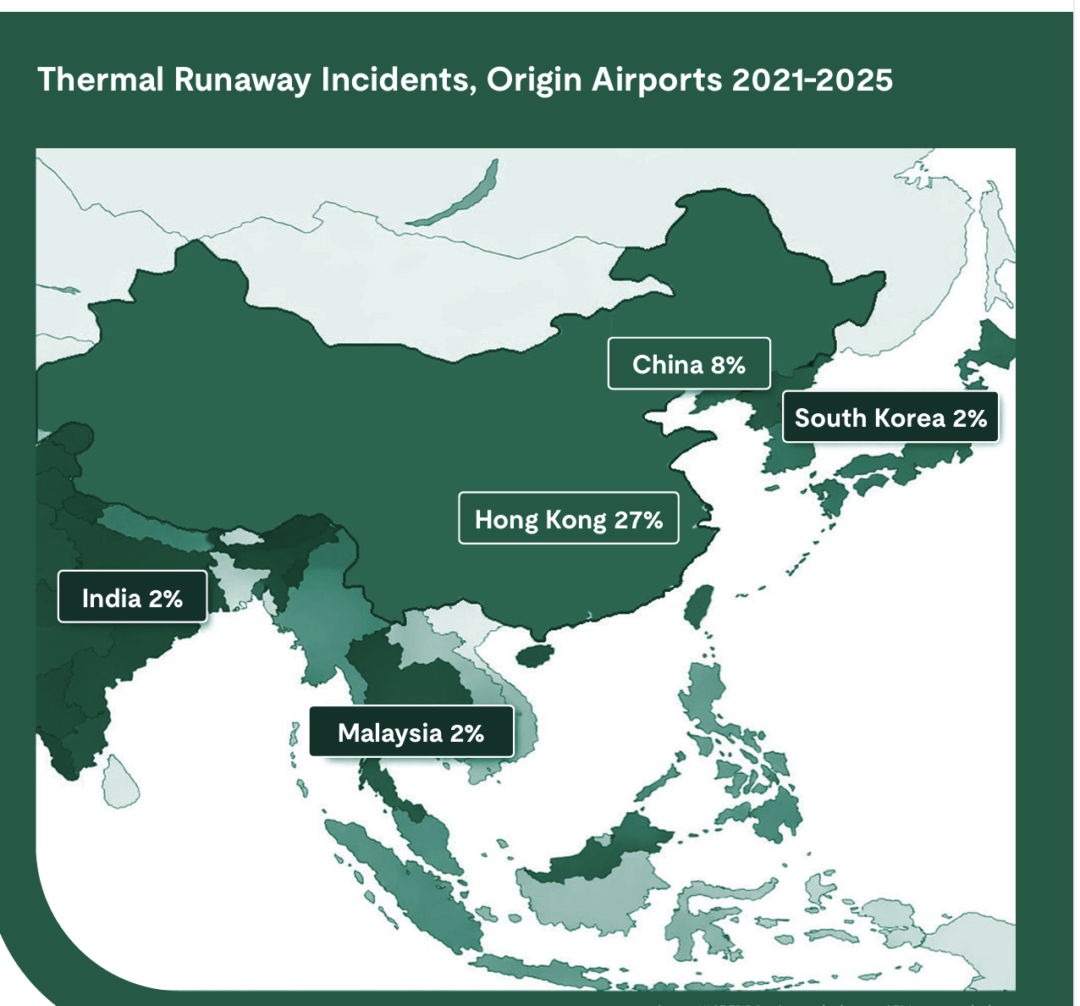
Geography also plays a role. Around 42 percent of incidents with known origin data were linked to shipments originating from airports in Asia – a reflection both of production concentration and differences in regulatory oversight, manufacturing standards and enforcement.
However, the report is clear that the issue is not tied to any single region. Rather, it is a function of a global system characterised by uneven standards, inconsistent enforcement and high commercial pressure.
This fragmentation is further complicated by multimodal transport. Lithium batteries frequently move across air, sea and road networks, each governed by different regulatory frameworks. This creates gaps that can be exploited — intentionally or otherwise.
The industry’s challenge is not simply to tighten rules, but to make compliance viable at scale.
Stakeholders point to the need for clearer allocation of responsibility across the supply chain, stronger education for shippers, and more consistent global enforcement. At the same time, safety must be treated as a commercial priority, not a cost burden.
Current practices suggest the opposite. The system continues to rely heavily on trust — a model that is increasingly difficult to sustain as volumes grow and supply chains become more complex. For air cargo, the implications are direct. With a significant share of freight moving on passenger aircraft, upstream failures in packaging, declaration or handling can translate into in-flight risk.
While aviation remains one of the safest modes of transport, safety risks are becoming more complex. Airbus data shows the global network carried more than five billion passengers in 2025, alongside an estimated 20 to 25 billion electronic devices, many powered by lithium batteries, making battery-related fire risk “a serious safety threat demanding collective attention” . As volumes continue to grow, the challenge is no longer limited to isolated incidents but reflects how modern supply chains are evolving under commercial and operational pressure.
Recommendations to reduce risk from UL Standards & Engagement
- Establish clear, enforceable responsibility across the supply chain. All stakeholders must understand and uphold their specific role in compliance, safety, and documentation. In a system where accountability is easily shifted, defining responsibilities — and enforcing consequences — is essential to reducing risk and closing the gaps that allow for plausible deniability.
- Strengthen education and global industry coordination to reduce ambiguity and prevent errors. Shippers — especially small and individual ones — need more guidance than airlines realize, and do not appear to be effectively accessing the guidance currently provided by regulators, cargo carriers, or e-commerce platforms. Coordination, data-sharing, and education can reduce confusion, misdeclaration, and reliance on trust alone.
- Treat safety and cost as aligned — not competing — priorities, and drive solutions from the top down. Cutting corners on battery safety, packaging, or testing creates greater long-term financial, operational, and reputational risk. Regulators and global standards bodies must lead with uniform rules, training requirements, and enforcement structures that make safety the most economically rational choice. Shipping batteries that meet safety standards can reduce risk, as these batteries have proven to be safer and less prone to fire.
The post Lithium batteries expose weak links in air cargo safety chain appeared first on Air Cargo Week.
Go to Source
Author: Anastasiya Simsek