
Mar 23, 2026
- Dubai’s airports demonstrated resilience during recent regional airspace disruptions, with airspace dynamically opened and closed in coordination with the General Civil Aviation Authority to maintain flight continuity and operational safety.
- Tactical adjustments at Dubai International and Al Maktoum International ensured cargo and passenger flows continued, preserving supply chain integrity for time-sensitive freight while processing over 1 million passengers in 17 days.
- Recovery is underway, with traffic at 40–45 percent of normal levels, and leadership is confident in restoring full capacity quickly while maintaining backlog management, safety, and customer confidence.
Dubai’s aviation system is demonstrating operational resilience under geopolitical strain, with leadership signalling a rapid return to capacity despite recent airspace disruptions across the UAE.
Confidence in a swift rebound has been reinforced by Paul Griffiths, CEO of Dubai Airports, who indicated that the emirate’s airport network is already on a measurable recovery trajectory following temporary closures triggered by regional instability involving Iran.
Close coordination with the General Civil Aviation Authority enabled rolling closures and reopenings of airspace, allowing aircraft to be diverted through designated corridors while maintaining safety and continuity.
“Our ability to respond to threats as they have unfolded have been very effective,” Griffiths stated. “We have closed airspace and opened airspace as the threat has changed. “We’ve been able to keep aircrafts in the air and route them through corridors that are properly designated by the GCAA.”
For cargo operators and freight forwarders, that distinction is material. Maintaining airborne continuity, even at reduced volumes, avoids the compounding delays associated with ground holds, slot dislocation, and missed interline connections. In a hub-and-spoke system as tightly wound as Dubai’s, where long-haul widebody capacity underpins both passenger and bellyhold freight, preserving flow integrity is essential to keeping supply chains intact.
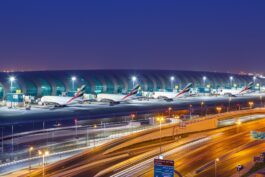
Operationally, both Dubai International Airport and Al Maktoum International Airport were required to absorb tactical adjustments. While DXB remains one of the world’s most capacity-constrained international gateways, DWC’s role as a logistics-focused platform provided additional flexibility, particularly for cargo movements less sensitive to passenger connectivity constraints.
Overall traffic levels are now recovering to around 40–45 percent of normal throughput. “We facilitated the journeys of over 1,000,000 passengers over the last 17 days and the recovery rate is significant,” Griffiths explained. “When that supply chain gets interrupted it’s incredibly important that we keep people informed, keep people already at the airport safe and secure whilst we dealt with the backlog and got people to the places they needed to be.”
Focus has now shifted to restoring network stability. Disruptions of this nature tend to cascade through global schedules, particularly affecting time-sensitive cargo such as pharmaceuticals, perishables, and high-value electronics.
Backlog management is critical. Airport operators have prioritised aircraft sequencing, stand allocation, and ground handling efficiency to clear accumulated volumes while maintaining safety margins.
“The airport has remained calm and composed and the many different comments we’re getting from our customers, I think suggests that for the most part, we’re doing a reasonably good job,” Griffiths concluded. “We are very, very convinced we are doing everything we can to preserve both the capability and the confidence to bring our operations up to 100% capacity as quickly as we possibly can.”
The post Dubai Airport bounces back despite Middle East turmoil appeared first on Air Cargo Week.
Go to Source
Author: Edward Hardy
Latest Posts