
Mar 16, 2026

- The Boeing 747 became a transformative aircraft for global aviation, with more than 1,574 built since 1969 and a major role not only in passenger travel but also in shaping modern airfreight through its high capacity and distinctive nose-loading design.
- Dedicated freighter variants emerged from the early 747-200F onward, followed by developments such as the 747-400F, Combi configurations and specialised versions like the Dreamlifter, enabling larger payloads, improved efficiency and the transport of oversized cargo across global networks.
- Although passenger operations have largely faded, the 747 freighter remains influential due to its payload capacity, flexible conversion programmes and continued use by cargo airlines, even as newer twin-engine freighters like the Boeing 777F and Airbus A350F signal the gradual transition toward more fuel-efficient aircraft in the coming decades.
To many of us, the Boeing 747 is a beloved icon of aviation’s sparkling history that has left a legacy on the air industry since it first lifted off over 55 years ago in the spring of 1969. Fast-forward to today in the mid-2020s, with over 1,574 examples of the aircraft having been built throughout the model’s illustrious history serving a multitude of purposes ranging from passenger travel to cargo.
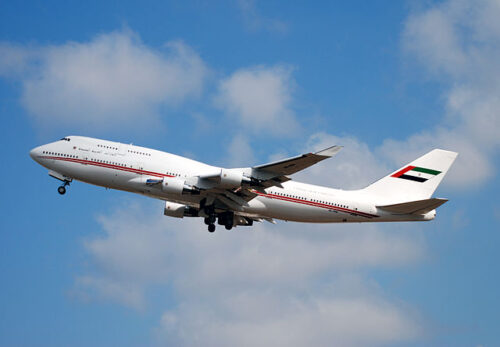
The 747’s impact on passenger travel could be considered a “pioneer” for international travel, with its introduction opening doors to airlines across the globe in offering long-haul, high density opportunities in a globalising society where travel eventually became the norm.
But that is just one part of it. Today, the focus will be on another area of aviation – airfreight, where the significant growth of international air cargo movement in the later 20th century coincided with the emergence of the 747 in the market.
The History of the 747 Freighter – and Evolution over the Years
The initial intention of the 747 was simple, acting as a short-term bridge to the expected boom of supersonic travel and aircraft manufacturing. Airlines were on the lookout for high-capacity options in the market as well, of which served as a driving point of the 747’s design phase and subsequent size.
But what about the long run? Boeing saw the latter as an opportunity that bode well into its long-term strategy for the Queen of the Skies, which was to eventually repurpose its manufacturing into that of a freighter in the decades to come. As such, certain features were developed with an eye on this strategy, the most eye-catching being its hump that placed the cockpit above the main deck so as to accommodate nose-in cargo loading.
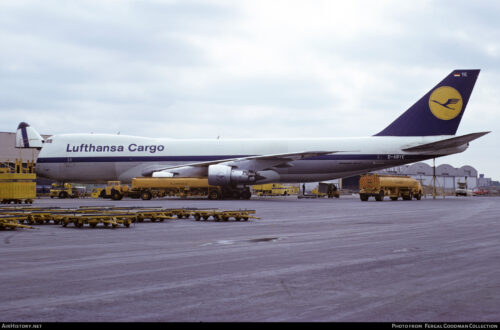
The 747-200 variant introduced the first iteration of a purpose-built freighter, entering service with Lufthansa in April of 1972 with subsequent deliveries to the likes of Japan Seaboard World, Japan Airlines and Northwest Airlines in the coming years. The conventional -200F variant tallied 73 in total, with a significant number (71) of its passenger-variant sibling converted into Freighters in the latter years of its lifespan.
For the 40 years that were to come from then, the Boeing 747 would be known as a trailblazer in the freight industry. Beyond the evolution of variant upon variant of the 747 freighter, new developments in technology enhancing fuel efficiency & aviation safety, freight in itself managed to evolve in part due to the modernisation of air cargo spearheaded through the 747. Perishable cargo, such as food, could be transported continentally, whilst in recent years, the rapid growth in popularity of global eCommerce was aided by the availability of airfreight.
The Variants and Uses of the 747 Freighter
The Boeing 747-100SF
Unlike its sister variants coming later down the line, the spearheading 747-100 did not see any purpose-built freighter models built. Rather, many of the type saw later service as Passenger-to-Freighter conversions that began in the 70s after Boeing received the initial Supplemental Type Certificate from the FAA in 1974 to perform conversions on the aircraft type.
The Boeing 747 Combi-Freighter
One of the more unique variants of the 747F, developments in customer requirements & innovation gave rise to the Combi-Freighter, an iteration of the 747 accommodating both passengers and cargo on the same main deck of the aircraft. The first aircraft of this type took flight on the 18th November 1974, with Air Canada as C-GAGA.
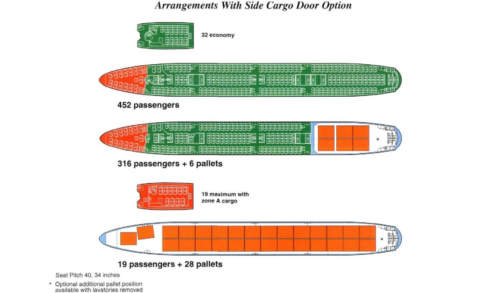
The combi freighters were versatile, its biggest selling point. Operators had the option to modify the passenger/cargo space on the main deck based on seasonal demand, whilst also optimising revenue on high-demand routes such as New York to Frankfurt or London.
There were challenging technicalities that came in the package however. One of those came in the form of Dangerous Goods (DG) – with certain classes such as class 8 corrosive dangerous goods permitted only onboard freighter aircraft and thus did not qualify to be carried onboard the 747 Combi. Additionally, the unique nature of the aircraft meant that certain safety features i.e. mid-flight firefighting, relied upon manual means limiting safety provisions to Class A and B cargo compartment until safety concerns surmounted into revisions by ICAO during an incident onboard South African flight 295 in 1987.
Freighter Variants of the 747-300 and 747-400
In the mid-1980s, evolution of the Boeing 747 project continued in the form of the Boeing 747-300, a model that saw a total of 81 examples built.
Contrary to expectation – the 747-300 did not see any purpose-built freighter models, instead amassing 21 Combi models as well as 7 converted freighter examples of the type before its short-lived time in the headlines was eclipsed by the entry of its succeeding variant.
The inability of the 747-300 to sell well in the market led to crucial evolutions in the 747’s technology, later seen in the first 747-400 model. This included newer, fuel efficient engines, the addition of drag-reducing winglets, and the introduction of a modern “Glass Cockpit” that eliminated the necessity of an onboard flight engineer – reducing the 3-man active flight crew into a 2-man crew.
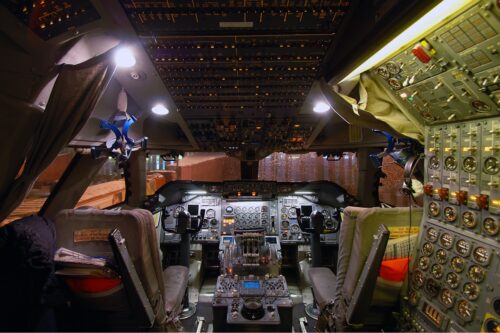
These innovations carried over to the Boeing -400F, where, together with other critical improvements such as an increase of nearly 20 tonnes in Maximum Takeoff Weight (MTOW), appealed greatly to major cargo players like Europe’s Cargolux due to its added range allowing non-stop flights from its hub in Luxembourg to the West Coast of the US.
The proven popularity of the 747-400 purpose-built freighter had, in later years, brought about further variations as well as conversion programmes. The -400BCF (Boeing Converted Freighter) has seen service with airlines like Korean Air, whilst the Combi Freighter version became favoured by Dutch flag carrier KLM & Chinese national airline Air China among other customers.
The Boeing 747-400LCF – a.k.a. Dreamlifter
A very unique aircraft designed specifically by Boeing to transport, the Dreamlifter is probably the most extraordinary variant of the Boeing 747 freighter family.
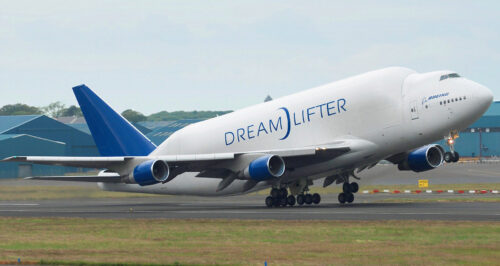 The model was first proposed in 2003, in chronological conjunction with Boeing’s upcoming 787 (then known as the 7E7) programme. Largely in part due to the way 787 components were manufactured, with the fuselage assembled in three separate parts, the manufacturer partnered with Evergreen Aviation Technologies Corporation in Taipei to design the 747-400LCF so as to transport these unusually large pieces of cargo to Boeing’s 787 Final Assembly Line (FAL) in the United States.
All in all, four examples of this unique freighter were converted, with each freighter still seeing active service with Boeing as at the time of writing.
The Boeing 747-8F
The last of the esteemed family, the Boeing 747-8F entered the aviation market at a time when the jumbo jet was progressively being phased out by operators worldwide in favour of more economical twin-engine freighters such as the 777F.
Indeed, industry trajectory suggests as much, with the Boeing 777F seeing a total of 362 orders to date, from its initial release in 2009. This was more than triple the total seen by the Boeing 747-8F in its 16 years (2005-2021) of production (109)
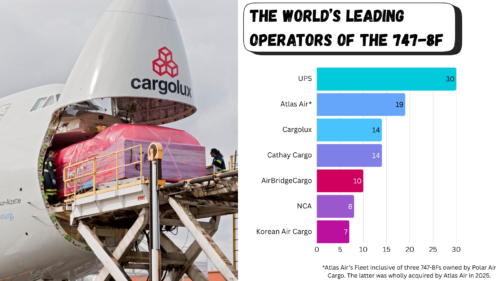
Nevertheless, whilst the passenger iteration of the aircraft saw minimal interest, cargo operators such as UPS, Atlas Air and the now-subsidiary of ANA, Nippon Cargo Airlines (NCA), decided to invest in it, indicating its appeal & impact for the operations of certain cargo airlines.
High tonnage and capacity – The key sellers
Airlines, especially those from the airfreight industry, love the 747 for a few reasons. An important factor lies in the volume of cargo it is able to carry on a single trip between two points.
The concept behind this is similar to container shipping, where movement in bulk reduces costs. The key contributor to costs when moving goods via air has always been due to fuel & manpower expenses from preparing numerous flights.
It came really as no surprise that the 747 soon turned into an exceptionally practical way of getting cargo from one point to another in a time-efficient manner. Compared to its immediate predecessor, the converted Boeing 707 Freighter, the 747-200F could carry nearly triple the amount of cargo in a single flight, as the former held ~34 tonnes of freight versus the 105 tonnes carried by the latter. As a result, flights became much more profitable in the long-term for cargo carriers despite the added fuel & capital costs required to operate a 747 Freighter.
The Range – not good, but not bad
The initial variant of the 747F, the 747-200F, had outstanding capacity – however lacked the fuel efficiency to carry the aircraft further than the distance between New York & London, with a maximum design range of just 6,695km (~3,615 nmi).
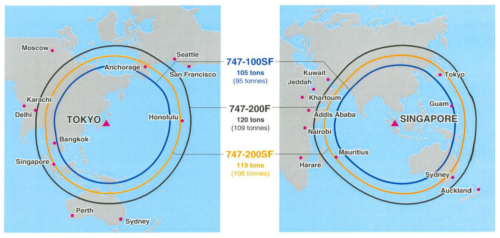
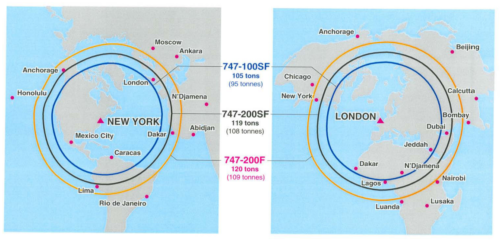
Over time, newer turbofan engines, as well as drag-reducing and fuel efficient features allowed the 747F to improve in terms of distance coverage, with the most recent iteration of the aircraft having the legs to stretch 7,900km in maximum revenue payload configuration.
Whilst seemingly average in comparison to its passenger-carrying peers, the aforementioned effective ranges were not an issue for cargo carriers. Many opted to operate fifth-freedom flights, in which relied on cargo hubs in moderate proximity to one another, allowing for optimisation of revenue through numerous high-payload configuration jumbo-jet freight flights.
Cargo unit contours
Between the 747 and the 707, the former had a fuselage width of 6.49 metres – larger than that of the 3.759 metres on the 707 – a 42% increase. With this development in aircraft manufacturing, cargo carriers were therefore given the ability to fit full Unit Load Devices (ULDs) containers into both the main and lower deck cargo holds, a significant improvement from the usage necessity of pallets & bulk cargo in the respective holds.
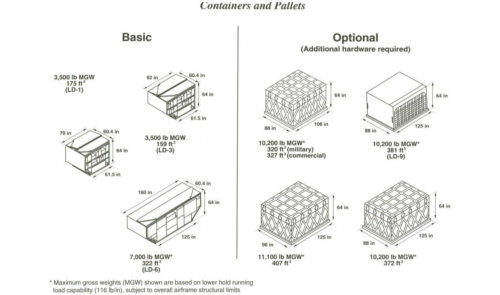
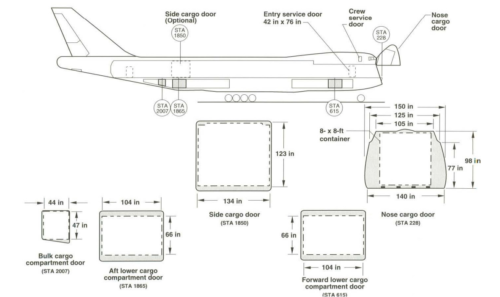
The shift from the Narrow-body Boeing 707 to the Wide-body Boeing 747 also presented an increase in the height of cargo units that could fit into the aircraft. The Jumbo’s main deck could now hold cargo units 96 inches in height via Nose-in Loading, while the lower deck accommodated ULDs that spanned 64 inches vertically. The 707 in comparison, maximised at 91 inches & 35 inches respectively.
Moreover – with the option of adding a side cargo door to the 747, operators could now stand to load cargo to a maximum of 118 inches in height by opting to install a side cargo door to purpose-built freighters. The height of cargo subsequently increased, meaning a greater volume of cargo per cubic feet fit onto the aircraft.
A illustration of a 118-inch ULD unit. Credit to Nippon Cargo Airlines (NCA)
The inventive design of the 747F permitted as such. Through the use of the Nose-cargo door, ground handlers were able to efficiently load & unload cargo between flights. Not only did it increase efficiency, it also permitted operators to transport odd-sized cargo, such as cars and large structures or even concert equipment en masse – cargo that became commonplace thereafter onboard the growingly popular 747F.
Passenger-to-Freighter Conversions Driving Longevity
Part of the ever-evolving role of cargo in aviation was the genesis of Passenger-to-Freighter conversion aircraft – also termed as P2F aircraft.
Immensely popular with airlines specifically operating both passenger & cargo fleets, the capacity boasted by the Boeing 747 freighters proved to be a popular option such that aftermarket conversions by certified Maintenance, Repair & Overhaul (MRO) later offered full programmes for airlines & aircraft lessors to convert & extend the effective lifespan of aircraft. Globally renowned MRO providers, such as ST Aerospace & IAI, in addition to OEM Boeing, played a role as catalyst in driving extended lifespans of many jumbo jets.
Per data from Airfleets.net, of the 20 oldest Boeing 747s still flying today, 9 remain plying the skies as freighter aircraft with an average age of 44 years, 1 month & 26 days between the aircraft, as at 20th November 2025.
A few key driving factors act as rationale behind the above.
- Age & Aircraft Aesthetic
Revenue Passenger flights are typically operated by aircraft with state-of-the-art cabin products. Needless to say, cargo would not require such components onboard. Older aircraft, whilst sometimes costly to maintain, have a tendency to serve as a freighter in the latter years of its lifespan as the sometimes worn out exteriors & interiors do not require constant upgrading & maintenance.
- Opportunity Cost of Purchasing New Freighters vs Converting Current Aircraft
Primarily for airlines already operating variants of the Boeing 747, the availability of aftermarket conversion programmes allow for the extension of aircraft service life. Especially with premium airlines, aircraft tend to have a limited service life in part due to maintenance costs & wear and tear of interior & exterior components such as cabin seats, and external paint.
Carriers with both passenger & cargo arms are able to not only reduce the necessity of purchasing new freighters, but also retain its capital investments for a longer period of time.
The Boeing 747F in the Present-Day – and an Outlook of its Future
A large number of airlines, in spite of the advancing lifespan of the 747, continue to rely on the aircraft for both passenger and cargo flights, with Boeing production of the jumbo freighter having ended only in recent history in 2023.
Largely in part due to the long-term reliability of the aircraft, the 747F has stamped its presence in the market & gained favour among many carriers, with some forecasting operation of the jet to continue into the 2030s & 2040s.
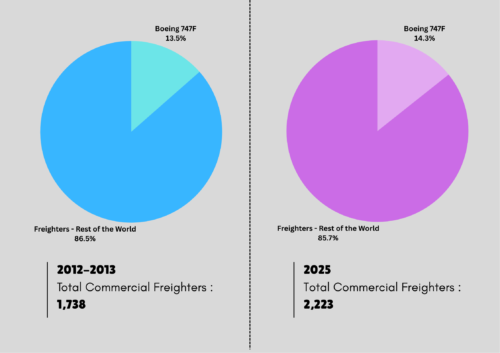
Certainly – we see a proportional increase in the 747 make-up of the global commercial freighter fleet, largely brought about by the cessation of jumbo jet production, progressive retirements of passenger 747 aircraft and continued P2F conversions.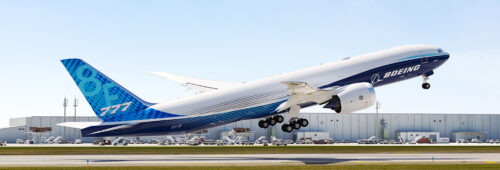
Yet, in spite of the seemingly continued presence of the Boeing 747F, airlines are looking into newer, more fuel-efficient twin-engine aircraft such as the Boeing 777F and the Airbus A330F to serve as the cornerstone of their fleets, with orders & conversions for twin jets greatly outnumbering those for the 747.
The future too, suggests a similar story. With even newer twin-engine freighters like the Boeing 777-8F & Airbus A350F boasting comparable capacity to the 747F, their arrival on the near horizon in the coming years signal the sunset for the legendary queen as airfreight takes flight for a newer & more environmentally and cost sustainable era.
The post From passenger icon to cargo giant: The evolution of the Boeing 747 freighter appeared first on Air Cargo Week.
Go to Source
Author: Edward Hardy
Latest Posts