
Mar 04, 2026
- Middle East airspace restrictions linked to US–Iran tensions have forced thousands of flight cancellations and disrupted major Gulf aviation hubs.
- The crisis highlights the vulnerability of global passenger and cargo networks that rely on Dubai and Doha as key transit points.
Escalating tensions between the United States and Iran have triggered airspace restrictions across parts of the Middle East, disrupting flight schedules and forcing airlines to rapidly adjust operations across one of the world’s most critical aviation corridors.
While the immediate impact has been visible in grounded aircraft and stranded passengers at major Gulf hubs such as Dubai and Doha, the disruption is also exposing broader vulnerabilities within the aviation ecosystem – from airline scheduling and crew rotations to passenger protections and insurance coverage.
For insurers and travel providers, the situation is testing how policies respond when conflict-related events intersect with operational disruption. Many travel insurance policies exclude losses caused directly by war or military action, as well as government-ordered airspace closures. This means passengers whose trips are cancelled outright due to security restrictions may find themselves outside standard coverage provisions.
According to aviation data shared by industry observers, more than 9,500 flights were cancelled between February 28 and March 3 across major regional hubs including Dubai, Doha, Abu Dhabi, Sharjah, Kuwait and Bahrain. With an estimated average of 160 passengers per aircraft, the disruption may have affected more than 1.5 million travellers. Operations at Dubai International and Dubai World Central have since begun a limited resumption, with airlines including Emirates gradually restoring services while schedules remain fluid.
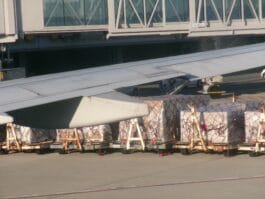
Beyond passenger disruption, the consequences are also being felt across cargo supply chains. Many European retailers rely on daily airfreight flows routed through Middle Eastern hubs for time-sensitive products. With logistics networks designed around just-in-time replenishment and minimal buffer inventory, even short disruptions can create knock-on effects in downstream markets, from temporary shortages to price pressure on supermarket shelves.
As Wouter Dewulf, Professor of Air Transport Management and Economics, noted in a recent analysis, “Dubai and Doha are not ‘just airports’. They are global transfer engines.” When operations at these hubs are constrained, the effects ripple across long-haul networks linking Europe with South Asia, Southeast Asia and Oceania.
In the short term, this creates a paradox for European carriers. With Gulf airlines facing operational limitations, some EU airlines could temporarily benefit from tighter capacity and stronger yields on Asia routes. Yet the operational penalty remains significant. European airlines are already avoiding Russian and Ukrainian airspace, and additional detours around parts of the Middle East increase flight times, fuel consumption and crew costs.
Cargo flows face similar pressure. Gulf hubs play a critical role in moving pharmaceuticals and other high-value freight, meaning even short disruptions can shift flows, tighten available capacity and push rates higher.
The post Gulf airspace tensions trigger flight cancellations and cargo disruption appeared first on Air Cargo Week.
Go to Source
Author: Anastasiya Simsek
Latest Posts