
Dec 04, 2025
- Most sustainability teams are down to just one person—and nearly all of them feel overwhelmed.
- According to a new briefing from Leafr, 67 percent of companies operate with sustainability teams of three or fewer, and 91 percent say they’re being pushed beyond their expertise.
- Yet the pressure isn’t easing. With climate shocks, disclosure mandates, and supply chain disruption rising, companies are having to do more—with less.
At the same time, new patterns are emerging: leaner internal teams, smarter use of AI, and a growing reliance on specialists for specific skills like LCA, climate risk, and scope three emissions tracking. Leafr’s forecast for 2026 doesn’t suggest decline—but a recalibration of how sustainability is resourced, reported and actioned across industries, including logistics and air freight.
At a recent briefing hosted by Leafr, the forecast for 2026 is clear: expect less headcount, more accountability, and an acceleration in digital tools like AI to plug the gaps.
The briefing revealed that 67 percent of sustainability teams surveyed consist of three people or fewer. Most common? A team of one. Far from signalling disinterest, this setup reflects a deliberate shift.
“Some of the most successful businesses that we have seen and worked with… have leveraged the team of one or the strategic core, and they’re bringing in on-demand experts to a T,” said Gus Bartholomew, co-founder of Leafr. “They are some of the leaders in the space.”
It’s not a rosy picture across the board. “76 percent of the respondents also said that they were not adequately resourced to be able to achieve their goals,” he noted. “91 percent of them had been asked in the last year to stretch into areas beyond their expertise.”
As companies reallocate budgets and restructure internally, they are increasingly relying on fractional consultants to respond to volatile market conditions.
Beyond resourcing, many sustainability leads remain siloed or sidelined. “41 percent of sustainability leaders cite lack of C-suite buy-in as a real problem, a real barrier to them being able to deliver,” Bartholomew said.
Reporting lines remain fragmented—into finance, operations, or wherever there’s space. That’s set to change as disclosures and supply chain risks escalate. “We’re going to see more sustainability teams reporting into CFOs and CEOs,” he predicted. “Businesses that are taking this seriously will start to re-elevate their sustainability functions to a much more strategic and kind of risk and transformation focused issue.”
While the number of sustainability professionals may be growing, the real bottleneck is specialisation. “There’s a huge amount of talent. There’s still very much a shortage of people with very specific skills… Supply Chain Management, LCA, climate risk assessments, circular economy skills, and scope three carbon accounting,” said Bartholomew.
This, he argues, marks a pivot point: “This is really going to be the era of change from generalist to specialist.” But many of these high-demand capabilities are needed only at certain stages or in project-based cycles. “A lot of these businesses aren’t actually tending towards saying, ‘Right, we need to hire a full-time LCA consultant.’ They just need access to that specific person as and when they need it.”
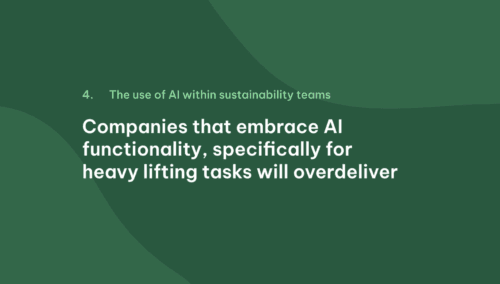
Despite the hype, adoption of AI among sustainability teams remains low. Only 19 percent of surveyed teams reported using it regularly. “Broadly, the sustainability function are definitely laggards when it comes to adoption of AI,” Bartholomew admitted. Concerns include environmental impact and a lack of internal capability.
But early adopters are already seeing measurable gains—especially in the time-consuming, repetitive tasks. “Where you’ve got this heavy lifting… around data gathering, reporting, drafting disclosures, supplier questionnaires… those are the areas we’ve seen it be leveraged really effectively,” he said.
It’s not about flashy AI pilots. “We need to do more rather than less. Less talk and more action, less time spent on reporting, and far more time actually spent doing the things that all of these lovely reports say that each business needs to do.”
Net Zero commitments are no longer the centre of gravity, especially for smaller businesses. “Only 11 percent of the businesses that we spoke to believe that they were on track to meet both their short term and long term sustainability goals,” said Bartholomew. “There is such significant risk here.”
In response, many are shifting focus to adaptation and resilience—facing up to the physical risks of climate change already impacting operations. “What’s actually most critical to our business? What’s most critical to business continuity?” is the question many are asking now, he said.
As Bartholomew put it: “Far more time actually spent doing the strategic work, doing the evangelising, doing the leading within their businesses.”
The post Sustainability 2026: Small teams, heavy demands, and the rise of AI in the green shift appeared first on Air Cargo Week.
Go to Source
Author: Anastasiya Simsek
Latest Posts